Theological Education Bubble II: Driving an SUV could make you a goat, but an atheist advocate of abortion might be a sheep

Close to forty years ago Singer wrote a powerful paper in ethics on the culpability of rich people in allowing the poor of the world to die. And yet rather than read that paper and Singer’s other work on the plight of the world’s poor, self-righteous suburban evangelicals continue to drive their big fat SUVs, tithe 4% of their income (on average) and stand in judgment of his views on abortion. What damnable hypocrisy. Before you call Peter Singer evil try reading the parable of the sheep and goats half a dozen times whilst setting aside your self-righteous certainty that you’re a sheep and Singer is a goat.

Randal Rauser, Associate Professor of Historical Theology, Taylor Seminary, Edmonton

I live in literalville.  I suppose Prof. Randal Rauser could provide nuance for the above quote that is cited at Triablogue, or perhaps deny that he made it.  But I find it curious that he would prefer an atheist and an advocate of abortion–which is in my book the killing of youngest, poorest and most innocent human beings–over evangelicals who drive SUVs.  Given that  abortions in the last few decades number in the 100s of millions, it is a genocide of epic proportions.  Millions of Rauser’s own contemporaries have already been snuffed out  (as he was born circa 1975, after Roe vs. Wade).

I wonder also about the finances of Taylor Seminary.  I know that they recently went through a financial restructuring.  Hey, all you donors and friends of  Taylor Seminary and College. Do you live in a suburb?   Do you drive an SUV?  Perhaps you think that abortion is worse than driving a SUV.  Did you realize that your hard earned dollars were going to support a professor who thinks that your driving a SUV is damnable?  Perhaps it’s time you got on the phone with the president there.

I’ve written about this sort of thing before. As a donor to theological education, I don’t understand why I, a business man and an investor, have to donate to progressive education which is inimical to those who create wealth.  It’s a contradiction and an absurdity, when the livelihood of those who teach in theological education depends wholly on such people.  For if we let this sort of thing continue, we will end up with theological students like PoserorProphet, and it is a waste of our money to help him along his way so he can teach others to be anarcho-marxist-zealot Christians like himself.

Signed,

A suburban driver of a big fat SUV (but only when my wife lets me drive it), who “tithes” a mere 2.64% on average

Why I think QE will create inflation and why it is qualitatively different than credit expansion

Meredith Whitney has come down hard on the municipal bonds and she is getting a lot of heat from others, including David Rosenberg.  But even if she is wrong, bonds of all sorts are bad investments because the US dollar is going to hell in a hand basket.  But what about shrinking credit which causes deflation?  I am no economist but here is why I think QE causes inflation while credit expansion is less inflationary:

Inflation is caused by too much money supply chasing too few goods.  Money supply can be created through credit expansion or through QE.  Credit expansion results in the creation of goods and services such as building of houses and manufactured goods, for every time a business borrows, its creates more real wealth in the form of its products.  Every time a home owner buys a house with a mortgage, the demand for new housing goes up and it results in larger supply of homes, i.e., more goods.  Thus, though credit expansion can obviously create bubbles, it also results in the increase of goods and services.

QE, quantitative easing, or the monetization of debt results in a disproportionate demand for goods and service without the creation thereof.  This is because the US federal debt is being monetized, and the US government in turn gives the money to government workers, pensioners, social security, welfare, food stamps, etc.  I.e. to people who increase demand without increasing the quantity of goods and services.  This increased demand, too many dollars chasing to few goods, devalues the dollar.

And this is why I think that QE leads to inflation and why it is much worse than credit expansion.

While helping the poor, remember to be human

[Originally posted here: While helping the poor, remember to be human]

Steve Hays recently wrote a post analyzing Peter Singer’s (the infamous advocate for infanticide) arguments about poverty. To briefly sum it up: Singer argues on a strictly utilitarian principle that every dollar earned beyond what someone absolutely needs should be given to the poor. No doubt, even if we haven’t read Singer’s arguments, many readers of this blog will have heard this logic expressed by a well-intentioned person at some point in their travels.

Now, Steve already replied along some lines, focusing partly on biblical principles and partly on ones of common sense, that would problematise Singer’s argument. But I wanted to suggest another possible line of response.

Stuart Brown (M.D.) and Christopher Vaughan have written a book about the function of play in the life of human beings (with some mention of its presence in other species as well), arguing about how important it is for human flourishing. They even spend time showing that some business managers have recognized this fact of human nature and have incorporated it into their businesses in some way or another, to good benefit for productivity.

These facts about human nature, then, would seem to suggest another problem with Singer’s position. For, if as all business-people know, “time is money”, by Singer’s logic, we should never spend any time playing. Yet, Brown and Vaughan have shown that play is necessary and beneficial for psychological flourishing and for productivity. The unavoidable conclusion from their work is that, in some sense, human beings need to spend some of their resources on play, rather than only charity, to be the best people they can be. Thus, Singer’s logic will inadvertently, if obeyed, lead to people being less helpful for the poor than they would be if they behaved more like human beings, and less like machines for helping the poor.

And in case the true darkness of such a Singerian ethically pure world escapes anyone, consider what Brown and Vaughan say:

The ability to play is critical not only to being happy, but also to sustaining social relationships and being a creative, innovative person.

If that seems to be a big claim, consider what the world would be like without play. It’s not just an absence of games or sports. Life without play is a life without books, without movies, without art, music, jokes, dramatic stories. Imagine a world with no flirting, no day-dreaming, no comedy, no irony. Such a world would be a pretty grim place to live.

Minimum wage

One of the factors in this last Great Recession that began in 2008 has been the Federal increase in the minimum wage implemented by US Congress.  Some believe that minimum wage laws actually increase unemployment, but it will be an uphill battle to convince most people that the current unemployment rate, especially of young people, is the direct result of the increase in minimum wage.  I would argue it is at very least a factor.

The builder of the library at the seminary in Africa where I taught told me a story.  He built these massive arches with concrete, all of it mixed by hand, and each arch in a single pour.  Each arch would thus keep dozens of unskilled laborers going several hours as they mixed with shovels and 5 gallon buckets.  One day, one of the workers said, “You know Ken, you should really buy a concrete mixer: just think how much concrete we could make with a mixer!”  So Ken said to them, “Ok.  I’ll buy a mixer but first you have to tell me which eight of you don’t want a job anymore.”

This is a general principle business:  if labor is cheaper than a machine, people will have jobs.  If machines are cheaper, then people get replaced by machines.  Fearsome Tycoon makes this same point: “Wal-Mart responds to a minimum wage hike by replacing more cashiers with machines … ”  At the same seminary, workmen cut grass with machetes.  Suppose the government decided that everyone deserved a raise and so they raised minimum wage.  Guess what?  The seminary would buy lawn mowers and lay off a bunch of people.  If they said you can’t lay off people?  They would just quit that country and go somewhere which didn’t have such onerous labor laws.  (Fearsome Tycoon makes this point too:  quitting is always an option).

In Ontario the minimum wage is about $10.  So as a consequence, there are self-serve check-outs in many of the stores here, including Home Depot.  They are not preferable to a human cashier, but one person making minimum wage can monitor four lines of customers.

Do you want high unemployment?  Increase the minimum wage and make sure that payroll taxes are high.  This increases the cost of labor and people will be replaced by machines or businesses will just simply quit.

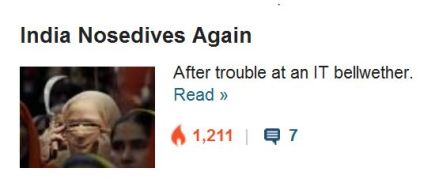
Business Insider does it again: Media malpractice

In previous post, I’d mentioned how a picture of an native in my hometown of Anchorage, Alaska, did not fit the Business Insider’s narrative.  I don’t know where these folks get their pictures.  The screen shot looks like this appears on the headline to an article by Joe Weisenthal:

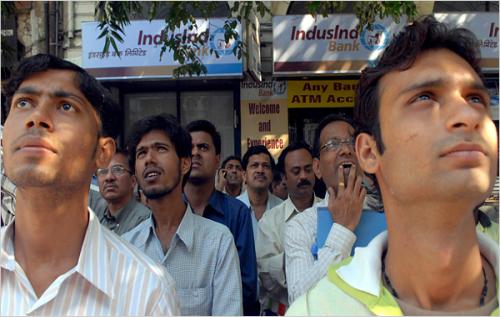
It doesn’t really look like the India Stock Market to me.  That looks like this (click on image for source):

]

Notice it is all men wearing shirts and no ties.  There are no veiled women wearing hats. No crescent moon knives.  The Business Insider provides images for their articles which are inconsistent with reality, but it does say something about their knowledge or rather their prejudices about India.  I wonder what the source of the picture is.  Furthermore, I wonder if it is indeed a picture of the India stock market as Joe Weisenthal’s use of it would suggest.  If anyone knows the source of the picture, please let me know.  If I am wrong, mea culpa in advance.  But my instincts tell me there is something wrong with this picture.