Anarcho-Socialism vs. Anarcho-Capitalism

[This is cross-posted at City of God]

In the wake of the emerging church movement, new attempts to grapple with a Christian approach to economics have become more intensely discussed and put into practice. One of the most popular “third-way” economics, at least in theory, seems to be anarcho-socialism. While, as with most things intellectual, there are variations on this position, there seems to be one or two positions that these variations all hold in common: (1) a labour theory of value, and (2) a dislike of economization and the price-system.

Lurking within many of these positions is a deep suspicion of “private property”. Of course, as with general view of anarcho-socialism, so in the case of private property, there are variations on how it is opposed. Nevertheless, if any sense is to be made of the “socialism” part of anarcho-socialism, some degree of opposition to private property must be present.

Part of the suspicion of private property comes from (1) above. That is, a labour theory of value, most fundamentally, believes that the value of any product must be the same as the value of the input of labour that produced it. By implication, this means if a labourer is paid less by an employer for the production of a good than the employer will make by selling it, so that the employer makes a profit off of the labourer, the labourer is actually being defrauded by the amount that the employer makes in profit. For, as was explained, if the object is worth however much the labour was worth, then there is no room left for an employer to make a profit, unless the employer is simply underpaying the labourer, or else is defrauding the customer.

Austrian economists, the consummate free-marketeers, in response, developed what is called the subjective theory of value (otherwise known as marginal utility theory). The subjective theory of value argues that the value of any product is determined by individual according to their preferences, and that market prices therefore are simply what the buyer and seller can agree on as a mutually beneficial compromise between their two value schemes, leading both to agree that economic exchange is more worthwhile than not exchanging. This fundamental view of value has many implications. It implies that wealth is not a zero-sum game. In any voluntary exchange, in fact, both parties believe they are actually increasing their wealth, simultaneously. It is a win-win situation, because both are getting something they prefer in exchange for something they prefer less. This means that real wealth is created every time a voluntary exchange occurs. It also means that the labour theory’s criticisms of profit are misguided.

The fact is, the existence of profit-making by an employer does not imply that the labourer has been stolen from, because it is entirely possible for a labourer to voluntarily prefer a fixed wage lower than the market price of a product rather than the chance of making the higher profit along with the attendant risks of being an entrepreneur. The labourer prefers a guaranteed wage now to a possible profits in the future, whereas the employer prefers potential higher profits in the future to a more secure income in the present. In the end, some people voluntarily prefer to be employees and have a more reliable source of income, and some people prefer to be their own employers and take on higher risk for the chance of a higher income. In situations like this, employers and employees have a mutually beneficial relationship; no one is being stolen from. Rather, the employer’s profit margin is higher than wage rates because the employer is the one risking his or her own capital; the labourer is not.

Some socialists have also issued criticisms of the principle of economy and of the price system. The former principle basically means just this: it is just a fact of existence that resources are scarce, and so rational agents will act to meet their ends with the least amount of waste possible. Waste, the destruction of wealth, is ultimately a harmful thing in a world where we do not have infinite goods to meet our needs. Rational people perceive this, and so act to avoid unnecessary waste. The converse of this point is that they act in the way they believe is the most efficient to achieve their ends. The price system is simply the social outworking of this principle. As was explained above, prices are just agents communicating to other agents what they think the value of a product is. When a price is agreed upon between a buyer and seller, both are convinced that the product has been appropriately valued, and they believe that they will be benefitted more by what they are receiving than what they are giving away. Socialists (again, as far as I know, some, though perhaps all) have criticized these principles as inhuman. Murray Rothbard, in a 1970 article, “The Death Wish of the Anarcho-Communists”, quotes one socialist making this point:

The anti-rational spirit of anarcho-communism was expressed by Norman O. Brown, one of the gurus of the new “counter-culture”:

The great economist von Mises tried to refute socialism by demonstrating that, in abolishing exchange, socialism made economic calculation, and hence economic rationality, impossible … But if von Mises is right, then what he discovered is not a refutation but a psychoanalytical justification of socialism … It is one of the sad ironies of contemporary intellectual life that the reply of socialist economists to von Mises’ arguments was to attempt to show that socialism was not incompatible with “rational economic calculation” — that is to say, that it could retain the inhuman principle of economizing. (Life Against Death, Random House, paperback, 1959, pp. 238-39.)

But, in response, Rothbard argues that it is in fact the denial of this system that is inhuman:

The fact that the abandonment of rationality and economics in behalf of “freedom” and whim will lead to the scrapping of modern production and civilization and return us to barbarism does not faze our anarcho-communists and other exponents of the new “counter-culture.” But what they do not seem to realize is that the result of this return to primitivism would be starvation and death for nearly all of mankind and a grinding subsistence for the ones remaining.

And it seems hard to deny this counter-argument. For, if an agent did not act in a way that attempted to be efficient with the use of scarce resources, they would lose those scarce resources through continual waste. And if a community of agents could not, or would not, signal to each other what they thought would be the most valuable/efficient use of a particular object would be through a price system, they would have no way of collectively acting in a way that would economize their scarce resources. And eventually, the continual waste of scarce resources would indeed lead straight into “starvation and death for nearly all of mankind and a grinding subsistence for the ones remaining.”

Thus, in the end, it seems that a capitalist understanding of wealth and property is necessary to prevent poverty and death; the principle of scarcity and the need to plan accordingly can be ignored only at our own peril.

With these criticisms made of socialist versions of anarchism, though, there is one valid criticism to be made of some forms of anarcho-capitalism. It seems (at least in my limited forays into their literature) many anarcho-capitalists (usually of the atheistic variety), believe strongly that there exists only one moral wrong: aggression. This means that letting another person starve to death, when you could prevent such an end, and there was no reason not to prevent it, would be perfectly morally licit. Obviously, this sits in stark contrast to the Bible’s command to “love your neighbour as yourself”, especially when it is seen in light of Jesus’ interpretation of it in the story of the Good Samaritan. It is quite clear that our Lord interpreted this fundamental axiom of the Law to require compassion and charity. This does not mean that everyone is required to share their goods in an absolutely equal fashion. In a situation where two people are both well off enough not to need charity, but one is richer and the other is poorer, there is no moral obligation for the richer person to share with absolute equality all of his goods with the poorer person. Absolute economic equality is not a requirement of natural justice. But, that said, human beings have a moral obligation to help our truly needy neighbour, insofar as it is possible for us to help them; this is matter of justice, of the Creator’s moral law, not subjective preference. God will not accept the rationalizations of the atheistic anarcho-capitalists on judgment day.

And so, one could perhaps argue that the only morally permissible type of anarchism is one which affirms two counterbalancing propositions: (1) the ultimate choice over what to do with property should lie with its private owner, not with a community acting coercively, but (2) private owners of property are still morally obligated to help their neighbours when it is possible for them to do so. The decision should ultimately be left with the individual (in the sense that the community should not use violence against them or their property), but the individual is obligated by God to show charity.

So, what does one call this kind of anarchism? Is it capitalistic, because it opposes coercion in exchange, supports the principle of private property, and denies an absolute moral imperative to voluntarily create total economic equality? Or is it socialistic, because it opposes an inhuman disregard for the suffering of others in affirming a moral obligation to show love to our neighbour? I tend to think that, because of the possibilities available for the meaning of the term “capitalist”, it is in fact capitalist. That is, because not all capitalisms deny there are moral obligations to help our neighbour, this “socialistic” principle does not rule out the appropriateness of the term. But maybe others will disagree. I think, however, in the end, this is just a semantic disagreement.


Theological education bubble VI: blowing bubbles overseas

Theological education overseas is a marvelous idea.  Basically it goes like this:  rather than send people overseas to do mission work, why not train the native leaders in local schools of theology and they will do the mission work in their own countries?  My experience is that these schools are expensive, rarely self-sustaining but in need of constant  stream of revenue from the West in order to survive.  Furthermore, the leadership is often compromised by the strings that control the foreign money.  But this is just the beginning of the woes.

The problem is even more profound in that the product of such schools is dubiously qualified to serve the church.   Why?  Because the focus is too often head knowledge and not issues of character.  Who is promoted in theological education, the most virtuous person or the most clever?

My own experience as an instructor is to try to teach people to be clever because I don’t know, especially in cross cultural context, how to teach virtue in a theological course.  Virtue must be caught, and it can rarely be taught.  So I can only really teach virtue by practicing it in front of others who are learning from me and with me.  But the classroom model is not adequate for this kind of learning.

I had the experience last year of a doctoral student explaining to me that he wouldn’t  return to Africa, despite signing a detailed contract agreeing to do so, and that he was just going to take a job here in the US which would then be his base of ministry.  Then he explained that his PhD had taught him to be an academic, a person that does high level theological research, and that he would not be able to carry out such elevated thinking and writing within the pressures of his African context.  This is symptomatic of the problem in academics generally, as Thomas Benton has written:

Also, remember that most grad students start out as dilettantes, thinking they’ll just hang out for a few years on a stipend. But eventually they become completely invested in the profession, unable to envision themselves doing anything else.

I told this man that his donors paid him to study at the PhD level so that he could go back to Africa and train leaders there, not so that he could teach undergraduates in America.  But to no avail, he would not give up the idea that it was ok for him to break his agreements.  We had trained someone who had no virtue but his cleverness had led him to think he could only be useful doing research like our funding had enabled him to do during his studies.  So the church in Africa has again been deprived of a great talent, and our North America scene has another developing world academic who probably won’t  return to work in his own context where such talent is actually needed.

But the problem does not begin at the level of doing the PhD in America.  It starts at a much earlier level.  Perhaps his own PhD supervisor was partially to blame; he wrote to me:

The ministry opportunities that are open to Michael [not his real name] in his home country would not enable him to use his gifts and training. Michael is a gifted scholar and writer; his dissertation is very well-done, indeed. He has spent many years working hard to polish his skills as a scholar. I would hate to see them “wasted.”

So there we have it:  a full time North America scholar at an evangelical seminary could not see how his doctoral student, with the training that he had received from him, could work in his own country given his skill set as a fine researcher and scholar.  Whatever occupation this man would find there working in his own church would be a waste. So says the man that supervised his very fine dissertation work, a very well-respected and well-known evangelical scholar who himself is the best product of Western theological education.  In my view, the only waste in this matter was the money spent training Michael at this particular supervisor’s school of theology!  Michael had learned to be clever, but he had not learned virtue: certainly not the virtue of keeping one’s word.

But I find that this is the problem with theological education in general.  I was promoted through the ranks and yet not for any particular virtues that I practice, whether goodness, generosity or gentleness, but because I was smart.  It has always been this way.  But shouldn’t theological education teach us to be people of our word.  What kind of God would we worship if He did not keep his promises?  Yet we are called to be imitators of God.  And to what suffering did our Lord Jesus Christ not submit?  Shouldn’t we be willing to suffer like Jesus Christ, who was obedient even unto death–and yet the only suffering we asked this African scholar to endure was to keep his word and return  and to use his training and skills to help the African church, because that is what his donors required of him before they gave him the scholarship to study in the US.

I wrote about the difficulty I had working in an evangelical setting because of the exploitation of desperate PhD labor.  In my opinion, theological education which is caught not taught is more profound than classroom training.  By mistreating adjunct labor, the theological school was actually teaching the students, without realizing it, that it was ok to be a bad employer and to exploit a glut in the PhD market.  First the theological schools create the glut by promoting too many people to the PhD level, then they exploit their labor by using them as part-time workers.  It is a vicious problem of exploitation, and yet this is what is modeled in many evangelical seminaries.

I have written that I question the efficacy of school as a model for theological education. But this model which is ineffective here in North America has been exported to the church overseas.  What can we do to resolve such issues?

While helping the poor, remember to be human

[Originally posted here: While helping the poor, remember to be human]

Steve Hays recently wrote a post analyzing Peter Singer’s (the infamous advocate for infanticide) arguments about poverty. To briefly sum it up: Singer argues on a strictly utilitarian principle that every dollar earned beyond what someone absolutely needs should be given to the poor. No doubt, even if we haven’t read Singer’s arguments, many readers of this blog will have heard this logic expressed by a well-intentioned person at some point in their travels.

Now, Steve already replied along some lines, focusing partly on biblical principles and partly on ones of common sense, that would problematise Singer’s argument. But I wanted to suggest another possible line of response.

Stuart Brown (M.D.) and Christopher Vaughan have written a book about the function of play in the life of human beings (with some mention of its presence in other species as well), arguing about how important it is for human flourishing. They even spend time showing that some business managers have recognized this fact of human nature and have incorporated it into their businesses in some way or another, to good benefit for productivity.

These facts about human nature, then, would seem to suggest another problem with Singer’s position. For, if as all business-people know, “time is money”, by Singer’s logic, we should never spend any time playing. Yet, Brown and Vaughan have shown that play is necessary and beneficial for psychological flourishing and for productivity. The unavoidable conclusion from their work is that, in some sense, human beings need to spend some of their resources on play, rather than only charity, to be the best people they can be. Thus, Singer’s logic will inadvertently, if obeyed, lead to people being less helpful for the poor than they would be if they behaved more like human beings, and less like machines for helping the poor.

And in case the true darkness of such a Singerian ethically pure world escapes anyone, consider what Brown and Vaughan say:

The ability to play is critical not only to being happy, but also to sustaining social relationships and being a creative, innovative person.

If that seems to be a big claim, consider what the world would be like without play. It’s not just an absence of games or sports. Life without play is a life without books, without movies, without art, music, jokes, dramatic stories. Imagine a world with no flirting, no day-dreaming, no comedy, no irony. Such a world would be a pretty grim place to live.

Business Insider does it again: Media malpractice

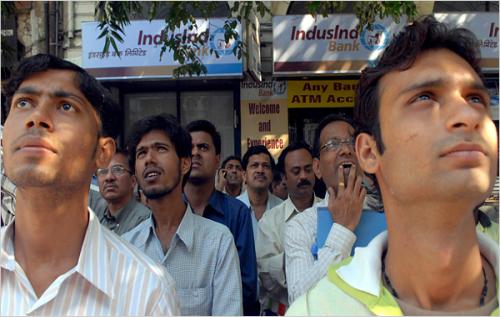
In previous post, I’d mentioned how a picture of an native in my hometown of Anchorage, Alaska, did not fit the Business Insider’s narrative.  I don’t know where these folks get their pictures.  The screen shot looks like this appears on the headline to an article by Joe Weisenthal:

It doesn’t really look like the India Stock Market to me.  That looks like this (click on image for source):

]

Notice it is all men wearing shirts and no ties.  There are no veiled women wearing hats. No crescent moon knives.  The Business Insider provides images for their articles which are inconsistent with reality, but it does say something about their knowledge or rather their prejudices about India.  I wonder what the source of the picture is.  Furthermore, I wonder if it is indeed a picture of the India stock market as Joe Weisenthal’s use of it would suggest.  If anyone knows the source of the picture, please let me know.  If I am wrong, mea culpa in advance.  But my instincts tell me there is something wrong with this picture.

Monopoly money vs. virtual money

I argued in a previous post that when banks create money electronically we shouldn’t call it “printing money”; the metaphor doesn’t adequately describe a situation in which most money is not printed but created electronically on the balance sheets of the major financial institutions then passed on to the public through electronic transfers, credit cards, debit cards, and the like.  Most money is not printed–it is a virtual reality that people accept in exchange for very real goods and services.  In my view, this situation is analogous to a game of monopoly.  During the game, the money is received in the form of salaries, rents, gifts, and bonuses, and in turn it can be used to pay rent, mortgages, penalties, and taxes.   In the end, when the game is over, all the money goes back into the box and regresses to its intrinsic value of zero.  But Monopoly is just a game, you say? But so is our virtual economy.  It’s a game we are playing with non-real money which has no intrinsic value, not even the paper its printed on, because the central banks don’t bother to print much of it anymore.

Monopoly games last about 1-3 hours.  It is not certain how long virtual economy game will last, but it won’t be much longer with Ben Bernanke keeping interest rates at virtually nothing and creating virtual money ex nihilo–eventually the public will stop accepting it in exchange for real goods and services.  That will be the end of the game, and at real money with intrinsic value, like gold and silver, will become the norm.  And we shouldn’t make the mistake of saying that gold has no intrinsic value because it can’t be eaten.  That is a fallacious argument created by fascists trying to confuse the issue.  Gold and silver have intrinsic value by definition.