The Education bubble III: Dumb smart people

Academics are very smart people who excel at school.  Those who do well in school are promoted to the highest levels of academia itself.  They are often very self-assured, smug  people who are convinced of the superiority of their smarts over such people as might find themselves working in a job somewhere or running a small business. These working people probably did not do that well in school–perhaps they were only ‘B’ or ‘C’ rather than ‘A+’ students.  Yet when it comes to tasks in the real world, I prefer the those who have actually worked at a real job in the productive world at least at some point in their lives.  The academic is likely to make a shambles of a real-world situation.  I agree with William F. Buckley who once said, “I’d rather entrust the government of the United States to the first 400 people listed in the Boston telephone directory than to the faculty of Harvard University.”  Yet nothing reveals the true nature of the education bubble better than when such academics fail in the real world.

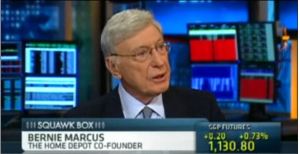
Now the Obama administration is made up of a lot of the Harvard-type academics who are very smart.  In this video at CNBC, Bernie Marcus, co-founder of Home Depot, talks about what is wrong with the Obama administration and the Democrats who control Congress: none of them have real business experience–they are predominantly academics who have tenure, not business people who have to risk their fortunes in order to make their small business succeed.  They seem to have no clue that their offer of federally assisted loans is not what is needed.  Washington is over-regulating small business, and every new regulation costs  money and forces businesses to downsize their workforce.  The best thing, according to Marcus, if you want to help business, is to shut-down Congress for a couple years, so that they can’t pass any more stifling regulations.  This is a must-see interview for understanding the malaise that is facing businesses in America.  It also helps us to understand the education bubble.  Perhaps only people with real world experience, who have worked, for example, as a truck driver or a commercial fisherman, should ever be allowed to teach in universities.  That way the theories that they teach in universities might have a chance of being related to practical realities on planet earth.
The education bubble II: Cost vs. results

A couple of charts illustrate keenly how costs in education, both at the K-12 and post-secondary levels, have escalated.  The first is from Carpe Diem (hat tip: Business Insider):

The second chart is from the Cato Institute (via American Thinker):

Perhaps the writer who has most exposed this bubble related to higher costs vs. quality of results, is Glenn Reynold of Instapundit.  See for example, this article in the Washington Examiner.

The education bubble I: Geography

Many have begun to write about the education bubble and I thought from time to time I would add a post about it.  Education is one of the sectors that show how badly government can wreck something given a chance.  I for one don’t think that taxpayers should have to pay for public education when the product is as bad as what is coming out of our schools–mind you, as a childless person, I feel it is unfair for me to pay for it at all.

Let’s consider this video of high school graduate, Kellie Pickler, and tell me whether the taxpayers got their money’s worth:

Polar bear searches in vain for ice

The Toronto Star reports that residents of Shamattawa, Manitoba, sighted a polar bear on the edge of town far south of the tree line.  We have learned from Dr. David Suzuki that the bear was apparently confused and wandering.  The famous zoologist stated to the Righteous Investor: “He seems to have been dismayed because of the lack of ice up north, and is searching too far to the south for unmelted ice upon which the species typically hunts for seals.  Then, as he wandered south, the intense Manitoba summer began to give him heat-induced insomnia and insanity.  Over-heated polar bears are dangerous animals and we warn people not to approach the bear and try to pet it.”

This is alarming news, just as many in Canada who drive hybrid vehicles were becoming smug about their reduced carbon footprint.  While it is true that children and others concerned about the environment throughout the world have become sensitized to the plight of the polar bear which often drowns in the Arctic ocean due to the scarcity of ice–the story of Nanooky, the young lost bear far south of his home, is a parable of the dangers of driving cars and turning on electric lamps equipped with the deadly incandescent light bulb–the root causes of global warming.  Suzuki said further, “It is time that people woke up and did something about their personal carbon footprint.  I recommend turning off your lights at night between 8:00 and 8:30; in addition, it could have immense benefits if every 5 minutes people held their breath for 30 seconds.  It is not that long, and most people, even the very young and the elderly, can achieve such a goal with practice.  But imagine the reduction of carbon emissions if a significant percentage of the world’s 6 billion people held their breath for 10% of the time!  It could end up saving the life of a young polar bear like Nanooky.”

Carbon dioxide is a greenhouse gas which is emitted by cars, electric lights and human beings.  It is toxic to the environment, especially to polar bears.  This is because it traps heat near the surface of the planet like an overcharged electric blanket.  After the polar bears become extinct, humans will be next.  But that would actually be good thing, as then the number of carbon emissions would be greatly reduced and the planet will begin to heal.  But we at the Righteous Investor only regret that the polar bears will probably become extinct first.

Hyperinflation when?

I first began to fear hyperinflation in my post “Obama and Inflation in Zimbawe“, on February 6, 2009, after learning of the absurd $1.4 trillion budget deficit.  These days, however, there are many economists and investment advisers warning of deflation.  The current pullback in the stock market seems to vindicate their position, though the current price of gold and Wallmart’s decision to increase its prices would not.  Meanwhile, my friend Keith is asking when is the inflation going to happen in earnest.  I don’t know when, but I am going to hazard a guess about when inflation is going to make its presence known.

Today in the American Thinker Anthony Kang points out a video from Opinion Journal, in which Jason Trennert says that the US government could be the next Bear Stearns because over 60% debt of the USA is due within one to three years.  What happens if the creditors decide not to rollover their treasury notes?  The Federal Reserve will have no choice but to monetize and that will likely put more of the debt back into circulation which will require printing more money (with real printing presses this time).  Will creditors continue to rollover their debt?  If so, then inflation may not hit in earnest until these creditors choose stop funding the US deficit.