Good Stewardship and the Imitation of God

Good Stewardship and the Imitation of God

Dr. Peter W. Dunn,

February 5, 2006, FATEB

Matthew 13:1-9 (NIV)

In John’s Gospel Jesus says that he has seen him has seen the Father (John 14.9).  Thus, we can say that one aspect of the mission of Jesus is to reveal the nature of the Father to us.  In Matthew’s Gospel, he says (Matt 11.27) that no one knows the Father except the Son and any one to whom the Son chooses to reveal him.  Thus, one very clear aspect of the Parables of the Kingdom is that Jesus is trying to reveal to Jewish people of his time what God is really like.   And there was then as there are today many misimpressions about God’s character.  In looking at the parables of the Kingdom, I would like to focus on the issue of God’s generosity, to complete a two part series on giving.  In the first sermon, which I gave Friday, January 27, I spoke about how we as evangelical Christians often view giving in terms of the law of tithing instead of as a charismatic gift of the Spirit.  I would like to continue this teaching of giving because I believe that when God pours out his Spirit into our hearts and our hearts overflow in generosity to others, we are actually becoming imitators of God.  Jesus does tell us that we must be perfect, even as our heavenly Father is perfect.  And Paul calls us to be imitators of God (Eph 5.1).  So I would like to study God’s generosity so as to be a better imitator of that generosity.

Continue reading

The Charismatic Gift of Giving or the Law of Tithing? Which?

The Charismatic Gift of Giving or the Law of Tithing?  Which?

FATEB – 27 January 2006  Dr. Peter W. Dunn

Acts 2.41-47

Acts 4.32-5.11

Romans 12.6-8

Introduction:  Having taught the books of Acts several times at FATEB, I have read several exegesis papers on the Acts 2.41-47 and Acts 4.32-37.  There was even at least one sermon here in chapel on one of these passages.  What has struck me is that in every case Fatebian exegetes and preachers have placed the emphasis so squarely upon the imperative:  this is what we must do if we wish truly to be the community of God.  When I have taught Matthew 5.20, where Jesus says that unless our righteousness exceeds that of the scribes and the Pharisees, we will surely not enter into the Kingdom of Heaven, I have told my students that the problem with our righteousness as evangelicals is that our righteousness too often IS the righteousness of the scribes and Pharisees.  Because our righteousness is the righteousness of the scribes and Pharisees, we see the actions of the earliest disciples, adhering to the apostle’s teaching, joining for the breaking of bread, the holding of all things in common, as prescriptions—things that God requires of us as Christians in order for us to be a good community of faith.  Since the absence of these qualities in our community continually besets us, we are forced to preach sermons and write exegesis papers making law out of passages which do not come to us in the form of a law, but as a description of true Christian community as it was experienced in the nascent church.  At least the Pharisees had the excuse that their tradition was based upon the Torah, which really is in the form of a law.

Continue reading

Intolerably Pharisaical Progressive Christians

Randal Rauser, Associate Professor of Historical Theology, Taylor Seminary, Edmonton, says that evangelicals who drive SUVs are hypocrites.

Poser or Prophet, Dan Oudshorn concludes that I am neither generous nor counter-cultural in my giving on the basis of zero evidence. (My tax returns are protected by Canada’s Personal Information Protection and Electronic Documents Act).  My wife says that if this is the kind of slim basis upon which he makes judgments, he is a very poor scholar indeed.

Brandon, a missionary in South Africa, judged me because I mentioned making a six fold increase in my RRSP through investing of which he is also critical.  Yet he doesn’t seem to ask his donor base whether their funding was appropriately gained, i.e., not through ill-gotten investments or usuary. As a donor to missions, I would certainly be less inclined to give to a missionary who is critical of the way I make money. I am not at all sure how such progressive views are going to help collectivist Africa either.

The one thing all three of these people have in common is that they depend on those who work hard and those who make risky investments in the real world.  They can sit in an ivory tower pontificating about how evil investors are; meanwhile, their bacon, their very livelihood, depends on the real-world risk taking of investors, who provide jobs, who pay taxes and who make it possible for missionaries, educators, and street workers to get paid to do their jobs.

Upside down interpretation of the Parable of the Kingdom

A few months ago, Andrew posted at City of God a few question, one of which was:

  • Does Jesus’ logic in the parable of the talents support the concept that, all other things being equal, it is more rational that people invest money than hoard it in the ground?
  • I responded as follows: In my view yes. Jesus is teaching from the known to the unknown; from everyday experience, in this case investing, to the unknown characteristics of the kingdom of God. Thus, Jesus is not teaching that investing money is better than burying money, but using that very assumption to point out something about the Kingdom of God.

    Then a certain Brandon responded (Brandon is a missionary in South Africa and if you would like to give some of your ill-gotten filthy usuary to him, you can link to this giving page here):

    1. March 6, 2010 1:48 pm

      Why do we always assume the parable of the talents is a glorification of free market principles?

      As he is much more eloquent than me, I’ll let the words of Ched Myers speak:

      This parable reads much more coherently as a cautionary tale about the world controlled by great householders (this is even clearer in Luke’s version of the story, Luke 19:11-27). Jesus may even have been spinning a thinly-veiled autobiographical tale here—for he, too, will shortly stand before the powers, speak the truth, and take the consequences. To read in it a divine endorsement of mercenary economics and the inevitable polarization of wealth is to miss the point completely—and to perpetuate both dysfunctional theology and complicit economics in our churches.
      The consequence of the third slave’s noncooperation is banishment to the “outer darkness where there will be weeping and gnashing of teeth” (25:30). We have presumed this to be “hell,” and so perhaps it is—that is, the hell on earth experienced by those rejected by the dominant culture: in the shadows where the light of the royal courts never shine, on the mean streets outside the great households, the dwelling place of the outcast poor like Lazarus (Luke 16:19-21). But the story that immediately follows this tragic conclusion—the famous last-judgment parable of the sheep and the goats (Matt. 25:31-46) may illuminate the nature of the dissident slave’s exile. This singular judgment story in the Gospels suggests that we meet Christ mysteriously by feeding the hungry, giving drink to the thirsty, welcoming the stranger, clothing the naked, caring for the sick, and visiting the imprisoned (Matt. 25:25-40). In other words, we meet Christ in places of pain and marginality; the “outer darkness.” The whistle-blower’s punishment kicks him out of the rich man’s system, but brings him closer to the true Lord, who dwells with the poor and oppressed.

      From here


    To this I wrote:

    Brandon, the parable doesn’t glorify free market principles. It uses an investment as an means of illustrating the nature of the Kingdom. Thus, the parable makes certain assumptions. Evidently, in Jesus’ day, no one would ever think it proper to bury a couple hundred thousand US dollars in the ground (on this understanding of how much is a talent, see Is Debt Sin ).

    The article Brandon cites starts out:

    Even more problematic than our sentimentalizing of kingdom parables is the way we misread Jesus’ parables about the world, reading them as if they were kingdom parables—with disastrous consequences. The most notorious case is the infamous parable of the talents (Matt. 25:14-30).”

    Matt 25.1, which is the near context says: “Then the Kingdom of heaven shall be compared to … ” (Τότε ὁμοιωθήσεται ἡ βασιλεία τῶν οὐρανῶν). Then vs. 14 (῞Ωσπερ γὰρ ), “For it will be as when …”(RSV); “Again it will be like” (NIV). BDAG suggest the meaning of ῞Ωσπερ γὰρ is “for it is just like” — i.e., we are not dealing with parable of the world as the authors suggest but with another parable of the kingdom. Their position is a severe violation of context.

    The article goes down hill from this statement to other false assumptions. One of which is the time period of the journey:

    In the 1st Century AD, without the availability of today’s electronic financial instruments, securities exchanges and stock markets, hedge funds, arbitrage, trading on margin, etc., to double such a vast fortune in currency within a journey’s time was unthinkable, and impossible through honest “work”. We today have difficulty hearing the story as those first listening to Jesus heard it, because in our day and age we are utterly habituated to dubious investment schemes, unlike the poor in Jesus’ audience.

    The period of time is unspecified. I always thought of it as about 10 years (“now after a long time”; μετὰ δὲ πολὺν χρόνον), perhaps because of the Odyssey, where the warriors were all gone 10 years, and the Odysseus himself was lost another 10 years. But in any case, the period time is a long time, not a short time, which the exegesis of Myers and Debode requires to be coherent. Brandon, I was able to quintuple one of my RRSPs (like an IRA) in 22 months. Does that make me a faithful servant or a dishonest investor, using the evil capitalist system make more myself “dubious” gain?

    Thanks for referring to this article. It will be easy to retort such tendentious “exegesis” in a future blog post at the Righteous Investor. Cheers.

    Then the following discussion ensued:
    Continue reading

    Extreme communism or just counter-cultural generosity? The case of Acts 4.34 and a dangling participle

    [NB:  There is a discussion of this post at:  City of God]

    The Book of Acts records two major passages in which counter-cultural generosity plays a significant role:  Acts 2.43-47 and Acts 4.32-36.  Some have read these passages as representing an early practice of communism in the primitive Church. Commenting on Acts 4.34, C. S. C. Williams, in Harper’s New Testament Commentaries (a.k.a., Black’s New Testament Commentary, Henry Chadwick, ed., 87), cites Easton, Purpose:

    In one matter Luke praises a standard even more rigorous than that actually taught by Jesus, for Luke is evidently delighted to tell of the extreme communism practised by the first believers.

    These passages in Acts represent the influence of the Holy Spirit on the Christian community, causing them to share in a counter-cultural manner.  But it is not communism by a long shot.  Here I mean communism in the sense of the relinquishment of private property, as some have understood Luke’s statement (Acts 2.44-45; RSV): “And all who believed were together and had all things in common; and they sold their possessions and goods and distributed them to all, as any had need.”  Yet it would do violence to the text to say that everyone sold everything they had to provide for the poor: Luke does not say that.  First of all, the pronoun “their” is not in the Greek.  Secondly, it would be justified to translate this sentence,  “They sold possessions and goods” (καὶ τὰ κτήματα καὶ τὰς ὑπάρξεις ἐπίπρασκον), the distinction between possessions and goods, is likely that one is immovable property (real estate) and the other is personal possessions (so F.F. Bruce).  Thus, I consider the usage of the article to be generic (see Dan Wallace, Greek Grammar Beyond the Basics, 227) not possessive.

    Now, let us consider Acts 4.34-35 (RSV):

    There was not a needy person among them, for as many as were possessors of lands or houses sold them, and brought the proceeds of what was sold and laid it at the apostles’ feet; and distribution was made to each as any had need.

    Now in order for Easton’s “extreme communism” to apply, we must again assume that everyone sold all their lands and houses.  Yet we find strong evidence that the Christians did not do this.  To begin with, the practice of Christians of “breaking bread” (cf. Acts 2.42) took place in private homes. So when Paul ravaged the church, he went from house to house to attack the Christians and to haul them off for punishment (Acts 8.3).  So whose houses were they meeting in?  It would appear to me that some of the Christians who owned houses hadn’t sold them.  Two such people are explicitly mentioned in Acts.  Mary the mother of John Mark owned a house in Jerusalem, where the believers met to pray for the imprisoned Peter (Acts 12.12).  And certain Mnason of Cyprus owned a house where Paul and his entire entourage were able to lodge while in Jerusalem–he is described as an early disciple (Acts 21.16), and was perhaps converted on the day of Pentecost along with many other Diaspora Jews, but for reasons untold he was able to stay in Jerusalem when the other Hellenistic Jewish Christians fled during the persecution of Stephen (Acts 7.1-8.4).  Philip, one of the first deacons chosen in Acts 6, was also an early disciple; he had a house in Caesarea that he didn’t sell, and there he lived with his four virgin daughters who prophesied (Acts 21.8).  Barnabas, the one person explicitly named who generously sold a field and was called “the son of encouragment”, probably retained some other holdings in Cyprus, for he returned there with his cousin John Mark after his dispute with Paul (see Acts 4.36-37; 15.39).  He sold a field but not likely everything he owned.  Still, this was a fantastic act of generosity.  Finally, the early church wasn’t practising communism, for in Acts 5.1-11, Peter says to Ananias and Saphira that the property, of which they allegedly brought the full sale price, belonged to them and even the proceeds of the sale belonged to them, and they could have simply given a part.  But instead they chose to give only a part and to pretend that it was the full amount.  Thus, Peter affirmed their right to private property.

    Now let us turn to the analysis of Acts 4.34.  If we are to accept the RSV translation, then we would most likely diagram the sentence as follows:
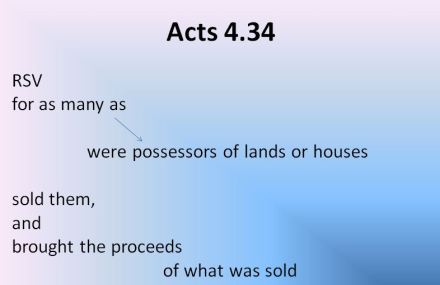
    The term, “for as many as”, is used in constructions like this:  “as many as did the one thing, did the other thing”.  So the suggestion of the RSV translation is that everyone who was an owner of a field or a house, sold them and brought the proceeds to the apostles, i.e., extreme communism.  There doesn’t seem to be much wiggle room.  However, as we have seen, Luke explicitly mentions people who still owned houses.  How do we reconcile this?

    There is a point of grammar in the original Greek that doesn’t come out in the RSV:   ὅσοι γὰρ κτήτορες χωρίων ἢ οἰκιῶν ὑπῆρχον, πωλοῦντες ἔφερον τὰς τιμὰς τῶν πιπρασκομένων, literally, “For as many as were owners of lands or houses, selling, brought the prices of the things that were sold”.  The participle πωλοῦντες dangles between the imperfect verbs ὑπῆρχον and ἔφερον, the comma being an editorial addition to the text (UBS4).  If we were however to translate using the second option, that the participle goes with ὑπῆρχον instead of with ἔφερον, this would require moving the comma to after πωλοῦντες instead of after ὑπῆρχον.  We then diagram the sentence as follows:


    Now the sentence makes more sense in the overall context of Luke’s Acts:  As many as sold the lands or houses that belonged to them, brought the proceeds to the apostles.  The text thus should not be forced to say that all the Christians sold everything they had, but that those who did were generous and brought the gifts to the apostles’ feet for administration.  The principle of charity towards the author (as Andrew has suggested to me) would play a role here:  the author, Luke, would not seek to write incoherently, suggesting at the same time that all the Christians sold their property but some retained their property.  The principle of charity would suggest that we interpret Acts 4.34, if possible, in a manner which does not create this contradiction.  Thus, I conclude that those who sold their property did so to provide for the community.  This is counter-cultural generosity.  But others did not sell their houses but rather made them available for the use of the community while maintaining ownership.  This is not communism.