Are Canadian junior and intermediate oil stocks in a bubble?

In 2008, those of us who were invested in the junior and intermediate Canadian oil and gas sector, experienced the collapse of a bubble.  I had bought 500 Enerplus, e.g., at $48, and I watched it collapse to $18.20 by March 2009 for $14,900 (62%) loss.  Losses for 100% natural gas Perpetual (pmt) were similar, only it hasn’t recovered much of its lost ground.  Midway Energy Ltd (then Trafalgar Energy) plummetted to a tenth of my original purchase price, but is now back up to $4.33, which is above the highest price that I ever paid for it.

As a result of an aggressive averaging down, oil and gas holdings in my current portfolio are now 65% above book–and that doesn’t take into account profit taking along the way, as I’ve taken the opportunity of the extreme volatility of the last two years to buy low and to sell high.  But with the buy and hold part of the portfolio, diligence is necessary.  Is there any sense in which there is a bubble–that these stocks are just too high and that it is now time to bail, or at very least to reduce?  This is a particular concern to me since my portfolio is 87% weighted towards Canadian junior and intermediate oil and gas companies.

The first consideration is commodity prices.  Natural gas is at a nadir.  Therefore, it is hard to imagine that natural gas weighted companies can go much lower.  These would include Terra Energy, Prospex, and Perptual (TT, PSX, PMT).  Oil is high at $80 but nowhere near where I believe it can go with a rapidly rising demand from emerging markets (esp. China and India) and the constant inflation being forced upon us by our central banks.

A second consideration is low interest rates.  At the moment, most of the intermediate stocks pay dividends far in excess of currents rates in savings accounts, GICs and short term bonds.  Thus, the sector is still attractive as investors seek yield.

A third consideration is fear.  About once a week I read an article indicating that retail investors, if not institutional funds, are still afraid to get back into the stock market, indicating that billions of dollars are still resting on the sidelines.  There won’t be a stock market bubble until more people are all in.

So let’s look at a few of the companies to determine if they are in a bubble.  Statistics are from the TD Waterhouse Market & Research, which I find is often inaccurate, but lets say for now that the numbers are representative of the larger trends.  Market price is as of close yesterday.

Petrobakken (PBN) $18.96 book 17.18 Price/Cash Flow 6.1x

Crocotta Energy (CTA) 1.77 book 2.52 Price/Cash Flow 9.1x

Midway Energy (MEL) 4.33 book $1.44 Price/Cash flow —-

Crescent Point 40.51 book $19 price/cash flow 11.2x

Prospex (PSX) 1.37 book 2.00 P/cash flow 9.4x

Now part of the story is that almost every company in the sector is ramping up its development costs in order to increase production and reserves.  Midway, for example, is on a fast pace of developing its Cardium holdings.  They have 150 drilling sites with an estimated netback of 4 million each (see their corporate presentation), which would provide a potential profit from these holdings alone of $600 million.  That is double its 294.6 million market capital.

Nothing yet indicates to me that there is anything remotely like a bubble in this sector.  Indeed, I am still bullish and think that there are still buying opportunities despite the recent surge in the sector.  In consideration also that the Obama administration has shut down future competition from new offshore drilling in the Gulf of Mexico–putting production behind by at least six months–the Canadian oil and gas sector begins to look extremely attractive.
New China Investment in Canada

Well good news to investors comes today from an agreement between Ottawa and Beijing to allow Chinese insurers access to the capital markets in Canada, which would bring in potentially billions of new dollars into the TSX and the Canadian bond market; this will undoubtedly help push up asset prices in our relatively small market, as the Chinese seek to diversify their holdings out of US Treasury instruments.  The Finacial Post says:

The China insurance pact comes on the heels of the decision by Ottawa to stop a proposed bid by Australia’s BHP Billiton Ltd. to acquire Saskatoon-based Potash Corp. The ruling sparked widespread worry among policy experts that Canada would find it difficult in the future to attract foreign investment, which is required to help boost innovation, domestic competition and lacklustre productivity.

The Financial Post suggests this is welcome news in the light of recent events. The Canadian journalist community had convinced themselves that the failed Potash bid of Australian mining company BHP would send a negative message to foreign investors.  However, according to a very thorough article in the Globe and Mail on the failed deal, the fault lies entirely with BHP, starting with their low-balling the initial bid, making it so that neither the Potash board of directors nor the province of Saskatchewan were much interested in the offer.  In other words, if you want Canadian assets, you better be ready to pay a premium for them, and that is as it should be.  The BHP bid of $130, though 20% above the price of the day of the offer, was ridiculously below POT all time high over $244.

In my view, this is another reason to be bullish on the Canadian oil and gas sector.  In China, there is a growing demand for energy and a diminishing stock pile, as the WSJ has pointed out (hat tip Devon Shire).  I believe that the Chinese insurers will seek out energy stocks as one of their main interests, as they know their own demand for the products will continue to force up the price.  Meanwhile, there are still deals to be made in the TSX.  For example, Petrobakken has made a serious dip since its quarterly report, as investors were disappointed with less than spectacular results caused  by wet weather which hindered drilling.  Penn West Energy and Pengrowth Energy are both dipping, having both been downgraded by TD Newcrest from Action Buy List, to Buy–based only on their recent, dramatic increase in share price.

Calculating book value: Case study, Petrobakken (PBN)

The value investor should pay attention to book value (assets-debt). I aspire to be a value investor, but I depend on stock analysts to do part of the work for me. Here is my dilemma. The discount brokerages make some of the research available to their clients to encourage their clients to invest in stocks. This generates revenue for them, as they depend on commissions. This is one reason to hold in suspicion their recommendations, since they will often be more optimistic than they should. If I always obtained the 52-week target price that they suggest, I would be probably be fabulously wealthy. That being said, their information is nevertheless very useful to me.

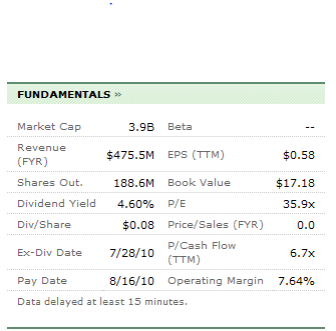
But what happens when their numbers don’t appear to agree, either with each other or with the reports from the company in question. Consider the case of Petrobakken, which both TD Waterhouse and Scotia Capital give a high rating. A couple of days ago I blogged that I would buy some shares, and I did, though the stock has continued to drop. Not to worry, I calculated that this growing oil-weighted company was selling at less than shareholder’s equity/book value; typically, if a private investor wanted to come in and buy the company, they would have to offer the shareholders premium on the book value in order to convince the majority of shareholders to relinquish the company. That means that Petrobakken is selling at a discount. I calculated the book value based upon  their quarterly report (in billions) as 5.5 (assets)-0.698 (net debt) / .188 (total shares)=$25.54 per share.

Now it is interesting to me that on TD Waterhouse website under markets and research, PBN is listed as having a book value of only $17.18:


Analyst Jason Bouvier for Scotia Capital lists PBN’s “value” at 4.467 billion and its net debt at 0.902 billion. Analyst Roger Serin at TD Newcrest (TDSI Morning Action Notes, August 11, 2010) reports PBN net debt as 1.642 billion. He provides the following explanation:

Balance Sheet – At the end of Q2/10, the company had net debt of $1.48 billion, with $557 million drawn on its recently revised covenant based $1 billion credit facility (previously $900 million reserve based). At year-end 2010, we forecast net debt of 2.5x trailing cash flow and 14% available on its current facility, or 30% with working capital deficit. Net debt includes US$750 million convertible debentures due 2016. We also note PetroBakken pays annual dividends of ~$180 million, providing additional flexibility.

I see. The debentures are added to the debt which is only correct. Using this measure we arrive at the following book value (in billions): 5.507-1.448/.1886=$21.52 per share. This is higher than the book value indicated on TD Waterhouse’s Markets and research page, and it is the price at which I purchased shares earlier this week.

Of course Petrobakken at the end of their report explain how they calculated “net debt”:

Non-GAAP Measures. This press release contains financial terms that are not considered measures under Canadian generally accepted accounting principles (“GAAP”), such as funds flow from operations, net debt and operating netback. These measures are commonly utilized in the oil and gas industry and are considered informative for management and shareholders. Specifically, net debt is used to evaluate financial leverage and includes bank debt plus and accounts payable and accrued liabilities, less current assets. Operating netback is determined by dividing oil and gas revenue less royalties, transportation and production expenses by sales volumes. Management considers operating netback important as it is a measure of profitability per barrel of production. Net debt and operating netbacks may not be comparable to those reported by other companies nor should they be viewed as an alternative to net income or other measures of financial performance calculated in accordance with GAAP.

There is no mention here of debentures. And this could explain the difference. Thus, there seems to be different ways that debt is calculated, and the DIY investor must be aware of this and dig a little deeper to make sure that the data being reported is accurate.

Book value as a determinant for buying a stock: The case of Petrobakken

At the current time, I am investing in the oil and gas industry for a number of reasons:

(1) Oil is a commodity based upon a US dollar price.  As the US dollar inflates, commodities will maintain their value.  As a result, there is likely a coming surge in the commodities in the market as everybody and his brother starts looking for value as they catch on to the severe devaluation of the US currency.  Already the Chinese, who are usually huge investors in US treasury bills, have begun to establish enormous positions in the Canadian oil sector.

(2) Current prices in the Canadian oil sector are mostly well below their 5 year highs.

(3) Canadian oil and gas companies pay really good dividends or distributions.

(4) Canadian oil companies, particularly in the junior oil sector, are often selling below “book value” or what is also called “shareholder’s equity”.

Today, for example, Petrobakken (PBN)  in their quarterly report stated that their total assets were 5.5 billion; their net debt 0.698 billion.  This means shareholder’s equity per share (total shares outstanding, 0.188 billion) = 5.5-0.698/.188=$25.54 per share.  I am not a stock analyst, so my calculations could be incorrect (and I would appreciate anyone correcting me on this).  Despite this report, because of the net loss during Q2, PBN shares fell to as low as $21.28 today, as disappointed shareholders dumped the stock.  Others like me were obviously establishing long positions.  I established long positions at an average of $21.56, which in my view means that I immediately gained equity of nearly $4 per share.  Meanwhile, before yesterday’s financial report both TD Waterhouse and Scotia Captial had given PBN excellent ratings, with a $30 and $31 52-week target price respectively [Update:  I learned that the book value of Petrobakken is probably closer to 21.52, and TD Waterhouse has lowered their 52 week target to $25].

I’ve read that Warren Buffet, the value investor par excellence,  does not like too much the commodities sector.  I comfort myself with the fact that there have been other billionaires who have made fortunes on black gold.