The best of worlds: the anthropological optimism of liberals vs. anthropological pessimism of conservatives

One of the significant differences between today’s conservatives and today’s liberals is that conservatives generally have a dim view of human nature and a deeper faith and trust in God.  So we are anthropological pessimists and theological optimists.  On the other hand, liberals want to make government bigger because they think it possible for human agency to procure well being, while conservatives want government to be small–with the exception of the military, for we believe that power corrupts and therefore government needs to be severely limited in scope and size, but that being said, the military is necessary because the world is an evil place and we need protection from other human entities such as terrorists and hostile foreign powers.  The liberal, on the other hand, optimistically wants to put power into the hands of bureaucrats as the solution to human woes, sees nothing but benevolence coming from larger government, but wants to reduce the military, evidently because there is no serious threat of terrorism or foreign invasions–i.e., anthropological optimism.

Conservatives are increasingly longing for the gold standard and today are buying large quantities of gold.  Liberals tend to support Keynesianism.  The difference again comes down to anthropology.  Liberals believe it is possible for an all benevolent bureaucracy to control the money supply.  I would generally agree that Friedman’s monetarism, as a middle position between Keynesianism and the gold standard, is probably the best system, but only when guided by wise and prudent leaders.  But when manipulative control-freaks are in charge of government, monetarism is too easily manipulated to rob the population through inflation.  Therefore, I’ve concluded that a gold standard, while placing limits on growth, would lead to greater stability and prosperity.  The gold standard places limits on human manipulation.  It would therefore prevent inflation, because gold is scarce and cannot be easily made un-scarce, as can fiat money; and it would lessen the swings in the business cycle, for the ability to demand gold for bank notes would greatly limit the expansion of credit.  Keynesians actually believe that an all benevolent government can prime economies for the well-being of all.  It is the replacing of of faith in God who cares for his creation with faith in humanity.  The gold standard recognizes human corruption and therefore seeks to curtail the evil tendencies in mankind–this may also slow growth, but that is the price that has to be paid to prevent the money system from falling into the hands of inept (viz. Bernanke) or corrupt (viz. the Democrat party) leadership.

It all comes down to a basic principle of St. Paul in Romans 3.23:  “For there is no distinction, since all have sinned and fall short of the glory of God.”
Ben Bernanke: Codependent in chief

From Marketwatch.com:

Federal Reserve Chairman Ben Bernanke called on Congress on Monday to adopt tougher budget rules even as the nation’s top central banker warned against taking deficit-cutting action too soon.

Still, Bernanke also warned against tightening too quickly and reportedly said more asset purchases by the Federal Reserve could help the economy.

The government’s addiction to debt and deficit spending is being enabled by the Federal Reserve which is buying its debt with money that is created ex nihilo.  So if Bernanke wanted, he could stop the addiction.  It’s like the wife who responds to her alcoholic husband who has asked her to bring him a drink, “Dear–you really must stop drinking so much … Would you like that on the rocks?”

Meanwhile, gold has climbed to $1330.

The education bubble IV: In celebration of $1300 gold

To celebrate gold hitting $1300 per ounce today, I dedicate this post to the schools that trained the beaming luminaries who have helped to make it all happen.  It was a group effort and we commend your universities for the brilliance of their alumni:

Barack Obama, Columbia, Harvard

Ben Bernanke, Harvard, MIT

Alan Greenspan, Columbia, NYU

Hank Paulson, Harvard (MBA)

Paul Krugman, Yale, MIT

Tim Geitner, Dartmouth, John Hopkins

Larry Summer, MIT, Harvard

By the way, I attended what is now the top ranked university in the world.  John Maynard Keynes was also a Cambridge man.

The Education bubble III: Dumb smart people

Academics are very smart people who excel at school.  Those who do well in school are promoted to the highest levels of academia itself.  They are often very self-assured, smug  people who are convinced of the superiority of their smarts over such people as might find themselves working in a job somewhere or running a small business. These working people probably did not do that well in school–perhaps they were only ‘B’ or ‘C’ rather than ‘A+’ students.  Yet when it comes to tasks in the real world, I prefer the those who have actually worked at a real job in the productive world at least at some point in their lives.  The academic is likely to make a shambles of a real-world situation.  I agree with William F. Buckley who once said, “I’d rather entrust the government of the United States to the first 400 people listed in the Boston telephone directory than to the faculty of Harvard University.”  Yet nothing reveals the true nature of the education bubble better than when such academics fail in the real world.

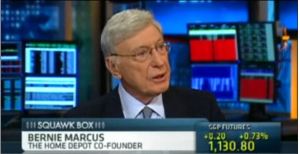
Now the Obama administration is made up of a lot of the Harvard-type academics who are very smart.  In this video at CNBC, Bernie Marcus, co-founder of Home Depot, talks about what is wrong with the Obama administration and the Democrats who control Congress: none of them have real business experience–they are predominantly academics who have tenure, not business people who have to risk their fortunes in order to make their small business succeed.  They seem to have no clue that their offer of federally assisted loans is not what is needed.  Washington is over-regulating small business, and every new regulation costs  money and forces businesses to downsize their workforce.  The best thing, according to Marcus, if you want to help business, is to shut-down Congress for a couple years, so that they can’t pass any more stifling regulations.  This is a must-see interview for understanding the malaise that is facing businesses in America.  It also helps us to understand the education bubble.  Perhaps only people with real world experience, who have worked, for example, as a truck driver or a commercial fisherman, should ever be allowed to teach in universities.  That way the theories that they teach in universities might have a chance of being related to practical realities on planet earth.

Hyperinflation when?

I first began to fear hyperinflation in my post “Obama and Inflation in Zimbawe“, on February 6, 2009, after learning of the absurd $1.4 trillion budget deficit.  These days, however, there are many economists and investment advisers warning of deflation.  The current pullback in the stock market seems to vindicate their position, though the current price of gold and Wallmart’s decision to increase its prices would not.  Meanwhile, my friend Keith is asking when is the inflation going to happen in earnest.  I don’t know when, but I am going to hazard a guess about when inflation is going to make its presence known.

Today in the American Thinker Anthony Kang points out a video from Opinion Journal, in which Jason Trennert says that the US government could be the next Bear Stearns because over 60% debt of the USA is due within one to three years.  What happens if the creditors decide not to rollover their treasury notes?  The Federal Reserve will have no choice but to monetize and that will likely put more of the debt back into circulation which will require printing more money (with real printing presses this time).  Will creditors continue to rollover their debt?  If so, then inflation may not hit in earnest until these creditors choose stop funding the US deficit.