O Anarchist, Where is your faith?

Christian anarchists, communists, and socialists seem to view the economic world as a pie.  You can only cut it up so many ways.  So if a rich person has a lot of money, then he has a larger portion of the pie.  For them, economics is a zero-sum game.  A poker game is a zero sum game:  at the end of the game there is only as much money as what the players originally brought to table–it’s redistributed differently, but its the same amount of money.  Thus, in the view of these people, if wealthy Christians have money, they have defrauded the poor.  That is why perhaps they support political systems that would force the wealthy to relinquish their riches; but in the end, where ever such a system is tried, everyone ends up living in dire poverty; communism shrinks the pie.  We’ve seen it in dozens of countries.  In my view, these Christians do not understand economics nor do they have sufficient faith in God:  “And without faith it is impossible to please him. For whoever would draw near to God must believe that he exists and that he rewards those who seek him” (Heb 11.6).

My goal as a wanna-be righteous investor is to increase the size of the pie.  Christian ministries don’t usually generate wealth themselves but depend upon Christian men and women who work jobs or who have successful businesses or other investments.  Those ministries like Streams of Justice which aim toward political advocacy requiring more funding for the poor will have a negative impact on the bottom line of these Christians and decrease their ability to give.  If we are smart, Christians donors must begin to resist the politics of envy and so-called Christians ministries which have lost faith in a big God and instead turned to big government for solutions.

I found an example of envy and of lack of vision on PoserorProphet’s blog, where he, in his typically jaundiced and imbalanced fashion, criticizes a large Vancouver church for mistreatment of the poor. The sycophants of his blog–I call them that because I’ve learned that if like me you are highly critical of Poser, he will not even allow you to comment on his blog–some of the sycophants of his blog believe that Broadway Church has defrauded the poor with the buildings which are “a country club” for its members.  The Pastor of Broadway, Darin Latham came online and defended the ministries of his church, saying that they do devote considerable resources to helping the poor:

You failed to mention, however, that hundreds of thousands of those dollars we raise feed over 150 homeless every Sunday morning of every week of the year, plus we supply groceries to 120 families every week, free of charge. We also run a free clothing depot… Not to mention a few geared to income housing complexes we operate throughout the city.

But despite his efforts, some of Poser’s readers were unimpressed:

Subversivechurch writes (sic):

Notice Darin does not touch on the topic of the operating expenses (salaries, ultilities, upkeep, etc.). And the chances are pretty high that he won’t either because when people start looking at the revenue… I mean income… I mean tithes of a church and where they go, you start to see why I refer to the IC [institutional church] as a country club. The amount of money that stays within the IC for the benefit of the members is vastly greater than the money that is used outside of the building. [snip]

Would a congregation realize that if they hadn’t built such a large structure, they could have helped a mother avoid depression by feeding and clothing her child, or a father not decend into violence because he can’t find work and feed his family?

Pastor Darin rightly defended his church as having the building to do all kinds of ministry: Christian education, counseling and worship.  For the subversives, the only thing they know is envy which sees economics as a zero sum game and God as so puny that he cannot provide all of our needs according to his riches in glory.  So they begrudge the church’s use of an expensive PA system:  Envy.  So why not have big mega-church?  Personally, I don’t like mega-churches and I think they come with their own challenges.  But if God called the founders of Broadway Church to build a mega church, then that is up to God, isn’t it?  I will testify, however, that the one time that I suffered from want I was helped by Frank Merriwether, who was at the time a College & Career Pastor at Broadway.  So I owe a debt of gratitude to that church.  Why is it that these arrogant anarchists believe that their agenda is the only one that Christians should concern themselves with.  They insist:  become like the poor, become homeless, identify with poor homeless, have solidarity with the poor–the whole world revolves around the poor.  Yet the homeless in Vancouver number about 3000.   I hate to tell you this, but there is over 600,000 people in that city and they all have spiritual needs, every single precious one of them.  It is not just about the poor.  It is about reaching out to the grandmother whose grandchild was killed in an accident and she can’t pray anymore.  It is about the parents who live in an upscale neighborhood whose daughter can’t be found.  It is about that depressed computer programmer who wants to swallow a bottle of pills.  It is about the widower who lies awake at night wondering if God is there. It’s about teaching kids about God in Sunday school; it’s about helping young people find their vocation in the Lord; it’s about helping the working poor and the working well-off, because we have spiritual needs too.  God cares for the poor, but he also cares for every single one of the rest of us too.  And it is about that guy at Regent College who was lonely and ran out of money while waiting for his student loan cheque.  John 3.16 says that God so loved the poor, right?  No, God so loved the world that he gave his only begotten son …  And what about these passages:

The Lord is not slow about his promise as some count slowness, but is forbearing toward you, not wishing that any should perish, but that all should reach repentance. (2 Peter 3.9)

This is good, and it is acceptable in the sight of God our Savior, who desires all men to be saved and to come to the knowledge of the truth. (1 Tim 2.3-4)

For to this end we toil and strive, because we have our hope set on the living God, who is the Savior of all men, especially of those who believe. (1 Tim 4.10)

But why can’t a church like Broadway, if some have a vision, have strategic ministries for the poor (which they do) and keep their building?  Is God so weak that he can’t provide both everything the church needs to pay for that wonderful facility and staff in addition to ministries for the poor?  Where is your faith?  These people have a puny view of economics and they have a puny god.

What happened to the Pauline concept of the body of Christ?  Isn’t it possible to have some people care for the poor and others who care for the elderly?  Some to care for the teens and others who dedicate their time to missions?  Why should the toe or eye say I don’t need you?  Why should the belly button say if you aren’t a belly button and do exactly what I do, you are not a member of the body, and you are not doing what you should be doing for the Kingdom.  Poppycock!

The Christian God, the one and only God, is big, and he has the resources of glory at his disposal.  He can provide Broadway Church both with resources to maintain their church building and to provide for the poor, as he calls the congregation to movement.  It is just simply silly to suggest that God would insist that they use that facility for the homeless or as a warehouse for feeding the poor, etc., when it is used by the congregation for worship, Christian education, and all the other ministries.  Beware, these anarchists are trying to sow seeds of dissension and envy, and the rest of us, the evil institutional church people, don’t have to put up with it.

Are Christian Anarchists the new Zealots?

Note:  This post has been edited to remove an error that the author acknowledges he made.

In my post Donate to Theological Education or Not:  The case of fighting anarchy, I wrote of my alarm that certain young Christians had begun to adopt socialism / communism.  As a donor to theological education, I’ve been asking myself whether if it is wise to give to schools like Regent College, of which I am an alumnist, that associate with professors like Dave Diewert who advocate such views. If these people succeed with their agenda, they will take away our ability to give to places like Regent.  One of Regent’s students, a self-acknowledged friend of Dave Diewert, has come out on his blog advocating violence and the abolition of private property:

However, as I have progressed down this road, I have become convicted that our efforts in this regard must be more intimately linked to solidarity with the abandoned, to the abolition of private property, to potentially more ‘violent’ means of resistance, and to the greater goal of building a social movement.

It had been suggested to me by one of Regent’s full-time Professors that the new left-wing Christians  were the New Pharisees; I’ve changed my mind about Christians like PoserorProphet who advocate violent resistance to the “economy of death”.  They are not the New Pharisees–they are the new Zealots.  Well, occasionally the two categories can overlap,  for Rabbi Akiba, a Pharisee, supported Bar Kochba, a zealot.  Poser has actually found inspiration in the actions of the Zealots:

Or, to pick a third example, we can find inspiration in the actions of the Jewish revolutionaries who immediately burned the records of debt after gaining control of the Jerusalem Temple in the first century (Josephus writes about this – although it probably reminds the modern reader of the conclusion to Fight Club!).

I wrote to Poser at City of God the following:

Now you advocate violent means of resistance and the elimination of private property. Just how much violence would you tolerate? You’re caught up in things that are way over your head, and you yourself could end up getting burned in the process. You mentioned favorably also the zealots who burned the papers of debt and murdered the priestly class. Did you know that all of those people ended up dead within four years? (Except through treachery, Josephus himself survived to tell the story). So you find inspiration in people who were exterminated by war, and those who survived the war only to be crucified and their women and children to be sold into slavery? They perished as Jesus predicted (cf. Matt 24-25); but he told his followers not to participate in the war but rather to flee (Matt 24.16-20). But of course you know better than Jesus–you’ve read more books than he did– and so you find inspiration in the actions of the people who perished in accordance to Jesus’ prophecy!

There was a time when the Republican party had to excommunicate from their ranks the John Birch Society because these people brought discredit to the party with their extreme conspiracy views.  I wonder if evangelical Christians, particularly those involved in theological education, need to clean things up a bit too, before they lose their credibility through their association with such people.  Or are they representative?  Do they actually speak what so many people want to say but are afraid to?

Crowded tenement building churches in Early Christianity, Part II: Philology

The first part of this series was published in my personal blog.  There I react to a budding Master’s student at my alma mater, Regent College, dubbed “Poser or Prophet”, who had in response to the Brooks’ post, House Churches, written:

Also, the early church probably didn’t meet in houses. They probably met in what space they could find in crowded tenement buildings — although if the wealthier first floor resident(s) converted, they could meet there (because, you know, with the risk of buildings falling over or burning down — which tended to happen frequently — it was much better to live on the ground floor than in the penthouse!).

I mentioned that while I often disagree with Poser, this time I agreed, and I was able to find an extensive, though dated, bibliography supporting his view, including multiple examples of the term πολυοχλοικοδομη (poluochloikodome=“crowded tenement building”) in the Early Christian sources.  Text after text supported Poser’s position.

Now Poser has deigned to respond to little ol’ me as such:

Hi Peter,

Methinks you’re a little behind on the literature. For more on churches in tenement buildings, you could start with Jewett’s Romans commentary (it’s pretty much a must-read anyway) and you can follow the trail he provides.

I was deeply moved that Poser remembered my name.  But I felt even more deeply chastened for having not read what is obviously a seminal source, Jewett’s Hermeneia commentary.  Fortunately, being a rich capitalist pig, I own a copy of this book in my personal library.  I was able to read some of it and must say I’ve come to the position of disagreeing with Poser.  Jewett helped me to see that the Greek New Testament that I was using, the NTCB (The New Tenement Church Bible, Greek and English Interlinear ed., published by Zondoudhoorn’s Press, 2009), had fabricated the term πολυοχλοικοδομη / poluochloikodome.  Also I learned that the NIV, RSV and numerous other translations of the original Greek text, just had the term “house”, where I had found “crowded tenement building” in the NTCB!  Can you imagine my surprise?  Returning to my other Greek Bible (I own several of these), I found that the term οἶκος / oikos was used in many of these passages; maybe I should have paid attention when Doc Pecota suggested that we should put our vocabulary on 3×5 cards for the purpose of memorization.  Its been 28 years since I took first-year Greek, so I had to get out my Greek and English dictionary; fortunately, I have several of these because, as I explained, I am a rich capitalist pig.  Imagine my surprise when I learned that this term means “house”; I didn’t think Jesus let his followers own houses.  This term, I learned, is translated domus in the Vulgate of which I also own a copy, being a rich capitalist pig–the term domus comes into English as “dom-inant”, “dom-ination”, “dom-ineering”–this would almost even imply that the apostles, in defiance to the teaching of Jesus, tolerated the early Christian rich capitalists pigs, allowing them to have a dom-inant role in the church; in antiquity, evil householders and landowners were constantly exploiting and dom-inating everyone else.  Heavens.

I couldn’t find in the Vulgate the Latin term, insula (“crowded tenement building”).  So I asked a couple of scholars (who shall remain anonymous to protect the guilty) who are also rich capitalist pigs, having both had the privilege of studying up to the PhD level, to their shame:  one is an Oxford-trained Papyrologist and the other a Swiss national–probably descended from bankers–a professor of Historical Theology, and neither one knew the Greek term for insula.  So I concluded that the original New Testament was written by people who at very least tolerated rich capitalist pig householders; perhaps they even used these economic structures of death to promote the advancement of the Early Church.  Horror!

More to come.

Worship the invisible God or our modern idols: Which?

Isaiah 55:1-9
Psalm 63:1-8
I Corinthians 10:1-13
Luke 13:1-9

Guidance through the Wilderness

Emmanuel Anglican Church, Sunday March 7, 2010

A Warning against Idolatry

Paul wrote 1 Corinthians to a very young church that he himself had planted.  But the new Christians at Corinth were confused about what is ok for a Christian to do.  So throughout the letter Paul offers practical instructions about how they must behave as Christians.  In ch. 8, he begins to give instructions about idolatry, and how the Corinthian Christians must act.  In ch. 8, he gives specific instructions about idol meat:  it was a practice in ancient world to sacrifice an animal to idols and then cut it up and sell it in the market place.  This was a difficult dilemma for Christians since most of the meat that they could buy had been sacrificed.  Could they eat such meat?  Paul also instructs these new converts, men and women who used to be pagans, that they must shun idol worship.  This was a hard lesson for these early Christians, because so much of life in the ancient world revolved around religion; in some cases, in order to belong to a certain profession, you had to worship in a pagan temple.  Some of the Corinthians had a pretty lax attitude:  they believed that they could partake in the feasts in the pagan temples, visit the prostitutes there, and none of this would harm them.  They were fooling themselves saying something like, “Food is for the stomach, sex is for the body, but my knowledge of God remains intact.  The whole world belongs to God and I can go into the temple eat and visit prostitutes and it will not harm me.”  But Paul is horrified and warns them not to visit the temple:  Even though there were no other gods besides the One God, they would be eating at the table of demons.  Then he recalls what happened to the Israelites, who were brought out of the land of Egypt; While in the desert they feared that Moses would not return from the mountain. So they had his brother Aaron fashion a calf out of gold and Aaron said to them about this golden calf ,  “This is Yahweh, who brought you out of the land of Egypt”; they began a feast with dancing, and they began to commit sexual immorality too.

Why Idolatry?

After many long centuries of Christianity in Western culture, we no longer practice idolatry.  So it is nearly impossible for us to relate to these passages. What was the motivation of the Corinthians to return to the pagan temples?  Why did the Israelites have Aaron create an idol?  My African friends who are first or second generation Christian may understand better than us.  Dr. Abel Ndjerareou, who once preached here at Emmanuel, said that he practiced idolatry at his grandparents house before becoming a Christian.  They are much closer to idolatry than we are.  Perhaps, a little story can explain what motivates idolaters:
Barthelemy Kombo, a Bayaka pygmy of Central African Republic, was afraid to become a Christian because he did not know how he would hunt without practicing fetishism—certain pagan rituals must be done to placate the spirits and make it possible to have a successful hunt.  The evangelist told him however that, while he could no longer practice his pagan rites, he could pray to God.  So Barthelemy decided to become a Christian but he was still worried that without the fetishist practice which made him a powerful hunter, he would be unsuccessful.  Not only that, but all the other Bayaka believed that he would become an ineffective hunter and that his family would starve.

Continue reading

Would Jesus have opposed the Olympic Games?

“But to what shall I compare this generation? It is like children sitting in the market places and calling to their playmates, ‘We piped to you, and you did not dance; we wailed, and you did not mourn.’ For John came neither eating nor drinking, and they say, ‘He has a demon’; the Son of man came eating and drinking, and they say, ‘Behold, a glutton and a drunkard, a friend of tax collectors and sinners!’ Yet wisdom is justified by her deeds.” Matthew 11.16-19 (RSV)

WWJD:  What would Jesus do?  It is a good question for Christians to ask because we want to be like the author and perfecter of our faith.  The protesters have objected to the Vancouver Olympic Games for the following reasons:  (1) they used unceded native lands; (2) they dispossessed the poor of Vancouver; (3) the games are a big party for rich people to which the poor are not invited; (4) they have been compared to the games in antiquity, an entertainment to mollify the masses.

In particular, Dr. Dave Diewert argues as follows (“A Call to Olympic Resistance”; emphasis mine):

One can hardly imagine Jesus, who in the wilderness temptation scene rejected the invitation to use his power and privilege to secure his own personal comforts, guarantee protection and security in his mission, and ascend the throne of political and economic domination, advocating support of the Olympic Games. The movement of liberation that he brought, the reign of God that he instantiated, was marked by standing with the weak and the vulnerable, challenging the powerful, and paying for it with his life. Loyalty to Jesus and his way requires saying NO to the temptation to power; the kingdom of God is expressed in solidarity with the poor, resistance to the ways of the empire, and liberation into a community of generosity, justice and mutual care.

The Olympics are the antithesis of the kingdom; they are the grand spectacle of the Empire, and its purpose is to lure us into its grasp. Herod the Great, the political ruler who ordered the slaughter of innocent children in an effort to eliminate the threat of Jesus’ birth, was a strong supporter of the Olympic Games. They are the mechanism of the economic elite and the politically powerful to seduce us into serving their interests. We need to stand with those destroyed or exploited by such power (indigenous people), with those expelled and displaced (poor people), with those punished and removed from sight (homeless people), because that is where our Master stood. It seems to me this puts us in a place of explicit non-cooperation with the Olympics.

Like Jesus in the wilderness, our stance should be one of resistance, dissent and non-participation. This might be expressed as public protest, or standing with the victims of exploitation and displacement, or engaging in educational strategies – all of which disclose the destructive power masked by the spectacular convergence of wealth and coercive force that the Olympics represents and promotes. The way of Jesus, the crucified one, is a narrow path that leads us into the company of the poor, the outcast, the afflicted; it is the way of solidarity with the victims of power, resistance to dehumanizing modalities of social existence, and liberation from destructive political and economic arrangements and into communities of shared resources, life-giving justice and care for all creation.

I suppose Diewert would think it inappropriate for a Christian athlete to participate in the competition.  According to CBC News, he is on the record as saying that it is even inappropriate for Christian groups, like the Billy Graham rapid response teams, to provide hospitality and support to visitors to Vancouver during the Olympics:

Dave Diewert, an organizer with the Christian social advocacy group Streams of Justice, which works on Vancouver’s Downtown Eastside, says it is inappropriate for Christians to associate themselves with the Olympic juggernaut.

“It seems unthinkable to align ourselves with the massive corporate enterprise as the Olympics,” Diewert told CBC News.

Dr. Diewert, please tell me that you didn’t say that and that you were taken out of context by CBC News.  But excuse me if I find this position just a bit moralistic.  I don’t think the term that I’ve dubbed for you and your Christian associates, the New Pharisees, is out of place.

I remember my first few months in Vancouver in 1996.  It was dismaying to learn that I shouldn’t drink most brands of coffee or tea because the workers weren’t paid enough or that I shouldn’t buy gas from Shell because the company was in collusion with the Apartheid regime in South Africa.  I just got to the point where I couldn’t function anymore with all the rules:  You can’t eat meat, that’s bad.  You can’t wear fur, because that means killing a fuzzy animal.  Now days you can’t breath because that contributes CO2 or fart because of the CO, evil greenhouse gases that are destroying the environment.  Young Christians fret about their carbon footprint.  They have so many rules it’s not inappropriate to call them the New Pharisees.  Now we can’t participate in the Olympics. It’s gone from Eric Liddell refusing to run on a Sunday to forbidding any kind of participation whatsoever, even providing aid to those in distress, because that would be displeasing to our Lord Jesus.  “If this man were a prophet, he would have known who and what sort of woman this is who is touching him, for she is an Olympian” (cf. Luke 7.39).  I don’t see how this is different from certain fundamentalist Christians who measure their faith based upon their adherence to rules, “Don’t drink, don’t smoke, don’t chew, don’t go with girls who do.”  I went to a Bible college.  I know something about rules.

Diewert claims that Jesus identified with the concerns of the poor.  Here is the conclusion of his unsigned paper (I assume it is his) on Matthew 4.1-11 (“The Wilderness Temptations [Matthew 4:1-11]” emphasis mine):

The wilderness testing scene finds Jesus, recently baptized by John, recipient of the divine spirit, and identified as God’s son, in a time of intense preparation for his mission. Hungry and weak, he is offered opportunities to use his status and privilege to secure his physical needs and desires, guarantee his protection and safety, and increase his political and economic power. Acquiesence to these offers would entail abandoning the mission of the kingdom he was sent to proclaim, and set him on a path that was incommensurate with the way of the cross. The path before him was one of solidarity with the poor and afflicted, resistance to the structures of oppression and exclusion and those who backed it, and invitation into an alternative reality of healing, forgiveness, community and love.

He remained true to this way, even though it would mean encountering hostility, conflict, suffering, torture and death. It was a path of non-compliance to the dominant institutions of power and control, and the embodiment of another vision of life in a truly human community. Using our privilege and entitlement to ensure our needs and wants are met, to guarantee the protection and security of our lives and our way of life, to lever more social, political and economic power constitute great temptations indeed. Increasing personal comfort, security and power is what we are socialized to desire and actively pursue. Yet to seek these is to turn aside from the way of the kingdom that Jesus brought, it is to declare allegiance to another god.

The Olympic Games event, it seems to me, functions as the grand festival of another god; it is the seductive spectacle that summons our allegiance to another master. It constitutes for us, followers of the Way who are embedded in the Empire, a profound wilderness-like test, an occasion for clarifying our loyalty and devotion to God’s movement of liberation embodied in Jesus.

Diewert claims that Jesus mission was one of solidarity with the poor.  Diewert can therefore justify his own work, as a community organizer who rationalizes envy on the part of the poor and violations of property rights.  He calls for political action to force taxpayers to provide housing and other kinds of funding for the homeless in Vancouver–thus, he is not against the wielding of political power; he just simply wants to shift power away from the status quo to a movement which will restructure our society to help these homeless folks.

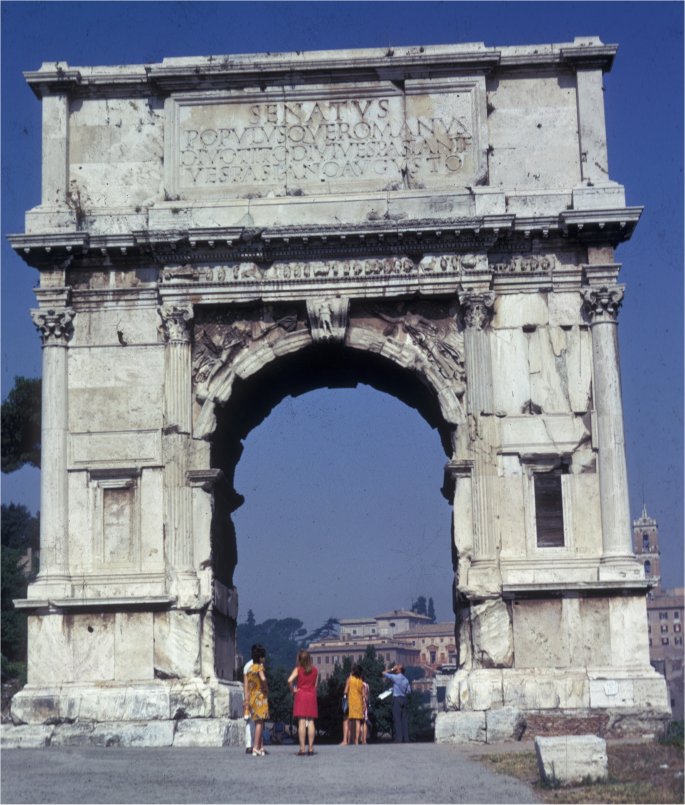
Arch of Titus, Rome

Before we accept Diewert’s position, I would like to point out that Jesus at the end was rejected by everyone: the rich and powerful, the elite, the priests, the Jews, the Gentiles, the rabble, and yes, the poor.  As the scripture says, “All have sinned and fall short of the glory of God” (Rom 3.23).  Arguably the poor Jewish crowd had much more to complain about than Vancouver’s poor.  They were oppressed by a foreign power who employed some of their own people to tax them.  Their own Jewish leaders worked in collusion with the Romans to maintain this status quo.  This was not just a few thousand poor people but nearly an entire nation in the millions that suffered as result of Roman rule.  But they maintained a strong hope of a deliverer, the promised messiah, who would save them and deliver them from the hands of the foreign oppressor, just as the Maccabees had succeeded  at overthrowing the Greeks in their recent past.  Jesus did not protect these poor people and he did not fight their battle.  Rather, he offended their sensibilities, causing them to withdraw from him (John 6).  Instead of delivering them from or resisting their oppressors, the Romans, he predicted their demise (Matthew 24-25) and told them that because of their rejection of him, the blessings of God would be stripped from them and given to the gentiles (Matt 22.1-14; cf. Luke 4.23-27).  When Jesus said “Repent for the Kingdom of heaven was at hand”, he affirmed the message of John the Baptist who said that the ax was laid at the root of the nation (Matt 3.10), and that judgment was coming, “You brood of vipers! Who warned you to flee from the wrath to come?”  So Jesus left these poor unrepentant Jews in the hands of their oppressors–though Christian tradition tells us that the Christian Jews escaped to a place called Pella in the trans-Jordan region (Eusebius, h.e. 3.5; cf. Matt 24.16).  While Jesus fed the poor and tried to heal them, ultimately he refused to deliver them from their oppressors on their terms, but allowed himself to be crucified, while the Romans triumphed–the Arch of Titus’ triumph of the Jewish nation stands to this day in Rome.

Diewert’s application of Matthew is tendentious; he attempts to show Jesus’ agenda as aligning himself with the poor. This is not the case.  He didn’t stand with the weak and vulnerable, as Diewert contends, but rather he stood alone before Pontius Pilate.  He was rejected by all people and he died for all people, men and women, slave and free, Jew and Gentile (cf. Gal 3.28) .  He called upon all people to repent, the rich, the poor and the religious and political leaders of his day.  That is why the position of the Billy Graham rapid response teams, of Eric Liddell, and of Christian Olympians seems far more balanced than that of the New Pharisees.  They can shine the light God in dark places of the world, so that some may be saved.  Jesus was apparently not against a big party, with dancing and drinking (Matt 11.16-19).  In my opinion, Jesus would not have refused to participate in the Olympics.  Why would he have refused when he was a friend of the prostitutes and the sinners? Jesus was even a friend of the very tax collectors whom the Romans used to oppress the poor.  Paul used athletic metaphors to make his point (e.g., 1 Cor 9.24-27), the very games that Diewert says that Herod loved so much.  There is in Paul a tacit acceptance of games, as having admirable virtues which were worthy of emulation.  So today, the Olympics games, while flawed, have many virtues that are worthy of admiration and emulation.