Commodity inflation is caused by monetary inflation

Cullen Roche of the Pragmatic Capitalist in his Dec 23 blog (via the Business Insider) made the claim that the rise in commodity prices has nothing to do with quantitative easing (emphasis his):

Well, I think it’s becoming pretty clear where the commodity price inflation is coming from – China and genuine economic strength.  The entire inflationist argument in the United States has been pretty much dead wrong for over two years running – whether you believed in hyperinflation, high inflation or default due to “money printing” you have been well off the mark.

Yet the inflation markers Roche is looking at exclude explicitly food and energy prices.  As one commenter on Gonzalo Lira’s latest blog points out, the media and the Federal government are lying:

Further the media and the FED are blatantly lying about inflation. Look at this CNN article that uses the slight [sic] of hand approach when talking about China’s inflation problems [Chinese inflation spikes on food costs].  After talking about the dangers China faces with it’s inflation it states in the article “Compare that with the United States, where the CPI has been sluggish for months. In October, the U.S. CPI increased a modest 1.2%, according to the Bureau of Labor Statistics. Excluding the volatility of food prices, the U.S. CPI rose 0.6%.”

So when it’s in China it’s inflation and when it’s in the US it’s not.  I’m not making this up.

But the fact is that somewhere around QE1, the Chinese stopped buying US debt and have been diversifying their holdings.  They are, for example, investing in oil companies in Canada.  This has resulted in a tremendous dilemma for the US.  How can they keep the behemoth of the US government running without that the Chinese invest in the Federal debt with their US dollars, made through the trade surplus with the US?  The answer is QE2, and Gonzalo Lira estimates that 60% of the new US treasury debt is now bought by the Federal Reserve.

And now, the problem of food inflation is much worse than ever.  Today, both the Financial Post and the Globe & Mail have prominent articles on the recent food inflation numbers.  Of course gold is holding around $1375; oil around $88; but these may end up skyrocketing in price soon.  Blame it on speculators if you like.  But this has everything to do with QE1,2 … infinity.  For the Federal government is now monetizing its debt and there is nothing even the newly elected Congress can do about it.  Even if they refuse to raise the debt ceiling, the government will just borrow the money from the Social Security and nothing will stop Bernanke from monetizing old debt as it expires.  When a government does this, they can expect commodities to increase: heating fuel, food, gasoline, textiles and eventually electricity.  These are the very things that we eat, wear and burn to live.  Now it’s happening and all over the media there is denial–not just the Pragmatic Capitalist, but all over the major media, even smart smart people like Niall Ferguson are still claiming that deflation is the problem.  But excuse me, when people can’t afford to eat anymore, that’s a problem isn’t it?  Are they stuck on stupid?

What happens during hyperinflation?

1.  Commodity prices, especially food, soar

In Weimar Germany food inflation was severe.  A bag of potatoes could buy a grand piano.  People used all of their disposable income just to put food on the table.

2.  Financial markets are highly volatile

The stock market in Weimar Germany would soar and plummet.  But in the end, shares in stocks lasted while the Weimar mark became worthless.  Commodity prices, though in a secular bull market, will remain volatile with huge swings as it rises steadily upward.

3. Gold and silver retain their value

In Zimbabwe, everyone who is able is a gold panner so as to buy food, for it is now possible to buy food with gold dust.

4. More stable currencies are desired

Many countries around the world use US dollars because their own currencies are so unstable.  Apparently US dollars are now legal tender in Zimbabwe.  In Weimar Germany, it would have been useless to own the likewise hyperinflated Austrian kroners instead of marks, but useful to own US dollars or Swiss Francs.

5. Real estate is uncertain asset

It may be worthwhile to own real estate debt just before an hyperinflationary period, for the value of that debt will plummet faster than interest rates can rise.  But it is also probably true that rental income will not keep up with inflation.  I read a story about hyperinflation in Chili in which a man was offered a condominium for his car.  The condominium, according to the author, is now valued in the hundreds of thousands, while the car sits in a junkyard.

What to do?

Perhaps it’s a good time to hoard large stores of food before the prices get completely out of hand.  Either that or an investor must have something that can be used to barter for food, such as wine or precious metals (in bullion–bars or coins), gold and silver.  In my view, the Canadian loonie may serve the role that the Swiss Franc did in Weimar Germany.  It is true that the loonie has suffered laughable interest rates, but the Canadian economy is resource rich and those economically healthy parts (e.g., China) of the world are pouring their money into the economy up here and are abandoning US debt.  So it might be good to have some Canadian money or some Swiss Francs.  I wouldn’t bother with the Euro at this point.

Memo to President Obama and Chairman Bernanke: A solution to the budget deficit

Dear Mr. President, and Chairman Bernanke:

I discovered a solution to the problem of the Federal budget deficit.  The deficit stands at roughly 1.5 trillion.  The solution is to print 300 billion 100 trillion dollar bills.  Obviously such notes would eventually be worth nothing in terms of currency, as was the experience in Zimbabwe.  But I’ve now learned that the 100 trillion Zimbabwe dollar note is selling to tourists at $5 US as a souvenir. 300 billion 100 trillion dollar bills at $5 each would be worth 1.5 trillion and you could sell them to collectors, tourists and speculators alike.

Just a thought.

Have a great day.

The Righteous Investor

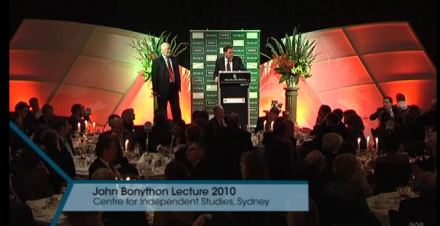
Niall Fergusson, John Bonython Lecture 2010

Speaking to the Center for Independent Studies in Australia, Niall Fergusson predicts the rapid demise of American hegemony in the world.  He explains that many empires did not ebb away but rapidly fell–however, in many cases, it wasn’t really military weakness that did them in, but debt, particularly debt to foreigners.  He says America is on the same path.  He makes the observation that China, which is rising in power, is quietly reducing its holdings of US debt.

Ferguson is asked during the question period whether he owns gold.  He says that one should only have 10% of holdings in gold, for he believes that there will be deflation.  Funny, in my reading of his book, The Ascent of Money, and my listening to media appearances, I’ve drawn the opposite conclusion from the evidence that he presents: that there will be inflation.  Ferguson, however, makes the point that he is not himself an economist (like that would necessarily help) but an historian.  In any case, I hope the leadership and people of the US are listening to his warning.  It is perhaps not too late to turn the tide.  Ferguson recommends the newly elected Senator Rand Paul as being the only one who has a reasonable plan to help the US to avoid this fall.  Please click on the screen snip below to connect to the video at the Australian Broadcasting Corporation website (hat tip The Business Insider).

The long and short of it: 2010 DIY summary

Our DIY investment portfolio has had a strong performance this year.  It is very difficult to determine actual performance because of contributions of new principle, but suffice it to say that our personal wealth experienced a 25% increase since January 1, 2010.  Considering that the TSX was up 14.4% this year, I shall now claim that I beat the index in 2010, and so far since becoming a DIY investor (Nov 2005) that has been the case: the TSX is up 15.8% over the last 5 years, while we are standing at 76% unrealized gain in our current positions (plus considerable dividends and realized gains over that same period). Our net worth has nearly doubled since June 2008 (before the meltdown) and our current rate of monthly increase is at 5.5 times what it was before I became a DIY investor in 2005.  I’ve discussed on these pages the strategies that I’ve employed (see category “investment tips”).  But to summarize below:

Long:  Gold, silver, oil & gas, sugar, loonie, Canada

Short: US dollar

Best moves:  Held Midway Energy (mel), up 48%; held New Gold (ngd), up 255%.  Added Crocotta Energy (CTA), up 53%. Used leverage in US margin account to buy Canadian high yield stocks (pwe, pgh, erf, pvx, avf.un) and traded favorably in and out of these positions.  Received approval to trade options and used them to great advantage–in particular, I greatly benefited from the sale of put options on Canadian oil and gas and gold mining companies (esp. the following–Canada exchange: cpg, dgc, gg, abx, pbn, pbg, day; US exchange: gg, abx, pwe, pgh, erf and ngd).  Increased non-margin credit facility by 230%: these consist of a loan from a relative (10%), two HELOCs (80%) and a unsecured line of credit (10%).  NB: Most of this credit facility is unused and left in reserve to cover put options–this allows me to safely sell more put options and not have to worry if there is a decline in excess margin credit in the portfolio.

Worst moves: Added more Perpetual Energy (pmt), new positions down 28% (overall position is down 35.6% not counting dividends); held Prospex (psx) which went to as high as $2.52, ended year at $1.31. Natural gas: bought Terra Energy (TT–up 0%), added more pmt, psx, Pace (pce).  Sold a covered call on Detour Gold and became more bullish afterward–this resulted in a $4.49 loss to buy back the call.  Failed to pay all taxes on income trust distributions in 2009 because an unintentional oversight by myself and by my accountant–I will seek a new accountant, and I’ve decided to include an income summary with all the paper work that I provide my accountant in the future: the CRA fined me 20% (over $1000–it was nearly $3700 total notice of reassessment) because of a similar oversight in my 2008 return.  The worst part of this whole episode is the fear of being on the radar of the taxman for the next few years.

Is this a recommendation to become a DIY investor?  I don’t know but it is an apologetic, since most financial writers in the official media say that retail investors do poorly and that they can’t beat the index.  After five years of experience and after not merely surviving but thriving in a period that included one of the worst bear markets in history (September, 2008-March, 2009), I have a growing confidence that I can consistently beat the index and make better money at this than at a day job.  While I won’t give a blanket recommendation to everyone to become an DIY investor, Adam Hamilton does recommend that everyone become a trader (see Monty Pelerin).