Review of Peter Grandich’s Confessions of a Wall Street Whiz Kid

Please take a look at Jonathan Chevreau’s column today; he reviews Peter Grandich’s, Confessions of a Wall Street Whiz Kid. Grandich was a Wall Street legend who realized the emptiness of his quest for material wealth. Here is an excerpt:

Early on, Grandich’s church-going was mostly for show and to accommodate his Catholic wife. But when he said his newborn daughter was healed by prayer in the 1990s, he began taking his religion more seriously. He “started to believe in God on a real, daily basis,” even though he viewed himself as a “sinner . and a big one, at that.”

Despite his wealth, he felt like most Americans that he was living beyond his means, so “super-downsized” his high-net-worth lifestyle.

Please read the rest at the Financial Post.

What does the sale of Daylight Energy tell us about the value of Petrobakken?

On the close of market on Friday, Daylight Energy had a market capital of CDN $976.9 million and a book value (according to TD Waterhouse website) of $6.06.  With the proper approvals, Sinopec will buy it for CDN $ 2,200 million which comes to CDN $10.08 per share.

Daylight Energy is a company that has similar assets, such as a large undeveloped Cardium base, to Petrobakken.   The difference is that Daylight has greater natural gas weighting than Petrobakken, and given the current commodity prices, Petrobakken should probably be more valuable.  But the thing that makes Daylight most like Petrobakken is the current debt load.  According to Bloomberg:

Investors feared Daylight’s relatively high debt load compared to peers, combined with a fall in oil prices, would crimp earnings, Geoff Ready, an analyst with Haywood Securities LLC in Toronto, said in a telephone interview. Daylight has total outstanding debt of C$872.5 million, according to data compiled by Bloomberg.

In this respect, Daylight is very much like Petrobakken–the market has shunned it for the same reason.  While both companies pay a great dividend, have great cash flow and sit on large, very valuable land bases, Mr. Market has spurned them and thrown them under the bus.  This is what makes them a great value investment.  I have written about book value in previous posts (e.g., here), that the price of a private sale of a company which has positive cash will never fall short of the book value of the company.  Unfortunately, the price for Daylight was only a small premium above book–just about $4 per share.  This is the true value of the company, not what Mr. Market is willing to pay but what industry insiders (such as Sinopec, a large Chinese Petroleum company), who would buy the business outright, would pay.

Therefore, I would like to assign a market value to PBN based on the same metrics (in CDN $$; book value from the TD Waterhouse website):

Daylight: book value $6.06; sale price 2.2 billion or $10.08 per share; sale price as a percent of book = 166%

Petrobakken: book value $17.43;  $28-29 per share (i.e., 166% above book price)

Now ultimately we have in this offer from Sinopec a fairer evaluation of the value of a Canadian dividend paying intermediate oil company than what Mr. Market is providing.  I would think that if you want to get in on Petrobakken or any other CDN intermediate oil company, it may be too late to do so based on the prices that we’ve seen in the last two weeks.  I’m holding my ground.

Furthermore, I would like to say that in the global monetary crisis that politicians and central banks will resort to currency devaluation to solve their problems–i.e., they will inject liquidity by recapitalizing banks, buying up troubled assets, etc.  The Chinese holders of debt are now in search for quality assets based on resources, and they are getting a steal with this offer to Daylight.  Personally, I am glad for the offer.  But as a shareholder of Daylight Energy, I will probably vote against the deal (provided that I continue to hold until the vote).

Nota Bene postlude:  Finally, I would add that this sale seems to repudiate the method of evaluating Petrobakken using only proven reserves (see herehere and here).  The Chinese experts have decided that the land is worth something–a lot more along the lines of the industry experts in Canada such as the CEOs of Petrobakken and Daylight Energy.    I would say that this sale makes some of us, who focus on the land base and the oil in the ground and such metrics as low book/price, look a lot smarter than some would allow.  A certain blogger offered some pretty self-confident and disparaging comments about how I was gonna lose money on Petrobakken and how I didn’t know what the hell I was doing.  To be sure, I’ve already lost a ton of money, but $25 is my top price for the company ($27 put minus) as I have averaged down from there (my average price is much lower).  I’ll continue to collect a nice dividend on all my shares until a buyer takes it out for $28+ or the market realizes what it’s really worth.

Chinese offer $10.08 per share for Daylight Energy

Subject to approvals, China’s Sinopec is buying Daylight Energy (DAY.TO) for $10.08, which closed at $4.59 CDN Friday. Here is another example, like Petrobakken, where Mr. Market doesn’t know what something is worth, but another industry giant does.  I feel sorry for those who bought at $11.74, the 52 week high. You win some and you lose some.

My friend Mich won big on this one.  He bought near the market close on Friday 1000 shares–that is a one day return of over 100%!  My returns are far more subdued.  I will make 8.8% return on capital at risk on this deal.  It helps me, because my current position was in the BIG RED.

But I’m not that happy, because this is Canada’s future, and I don’t think we should sell our assets to foreigners at enterprise value but at a significant premium.  But hey, it will bring capital into Canada and it will create jobs, and so I am happy about the short term help it will bring.

While this is 2.2 billion dollars and it seems like a lot of money, it fits into the larger meta-narrative:  The international trading scheme, whereby US consumers buy goods from creditor nations which in turn  lend the money back to the US government,  is unravelling.  This asset purchase is a rebuke of the US dollar, just as the dumping of $56 billion in treasury notes by foreign creditors.  We should expect more of this and as suggested by Zero Hedge, it is perhaps the beginning of the end of the US dollar:

Of course, there is a far simpler explanation [for the dump of 56 billion in US treasury debt]: the dreaded D-day in which foreign official and private investors finally start offloading their $2.7 trillion in Treasurys with impunity (although not with the element of surprise – China has made it abundantly clear it will sell its Treasury holdings, the only question is when), has finally arrived.

Reflexions on Petrobakken (Updated)

UPDATE October 4, 2011:  Devon Shire discusses the most recent news coming from Petrobakken and I agree with his sentiments expressed there:  http://seekingalpha.com/article/297554-is-petrobakken-in-play

The market has punished Petrobakken (PBN), not on any substantive news regarding the operations of the company, but on a downgrade by BMO:

BMO downgraded PetroBakken (C$8.22, -C$1.12, -12%) to underperform, saying “with a dividend policy that is looking increasingly unsustainable, PetroBakken continues to increase debt to levels that may be difficult to recover from.” It also said potential funding sources for the company may not be as readily available as in the past, given financial-market turmoil. PetroBakken is owned 59% by Petrobank Energy (C$8.16, -C$1.17, -13%), which is also down Wednesday.

As a consequence of this and the general market weakness in the last few weeks, Petrobakken has fallen precipitously in market price, from a 90 day intraday high of $15.11 to its close yesterday at $6.40.  It may fall still further, as some bullboarders have suggested it could go as low as $3.00.

Here are the main reasons that I’ve heard for pessimism:

(1) The debt now stands at 1.1 billion plus 0.75 billion in convertible debentures.  The fear is that the company will have to stop paying out the dividend.

(2) Weakness in world oil prices.   This actually should be stated as fear that there will be weakness in the oil price.

(3) The world-wide monetary crisis continues, and a general credit collapse could result in PBN’s lender recalling its 1.1 billion dollar loan.

(4) Petrobakken has paid way too much for its land base.

(5) The business model for Petrobakken is unsustainable because of fast decline rates for wells.

(6) Investors and would-be analysts are worried that something else is wrong that the company isn’t telling us but about which Calgary insiders are aware.  (Of course I know of no professional analyst who has made such an accusation).

These fears aside, here are my reasons for bullishness on the company and why I see it as a value investment and not a “value trap” as some investors have suggested.

(1) Petrobakken has two major land bases on which they have identified hundreds of drilling sites, in the Bakken and the Cardium.  There are billions barrels of oil in these fields which oil companies have identified after several decades of vertical drilling.  Petrobakken is on the leading edge of new technologies to produce these resources, including horozontal bilateral and trilateral drilling and multi-fracking, which will make it possible to extract more oil  than possible with vertical drilling alone.  But because these are already explored oil fields, drilling is de-risked–this is not wild-catting–i.e., drilling to determine if oil is in the ground, but drilling in oil fields that are already well-analyzed.

(2) Petrobakken already has excellent cash flow despite slow downs in production caused by bad weather.  They are still confident to achieve their exit production estimate (46-49,000 bpd) by the end of 2011.  If they achieve this objective, the share price could easily be around $20 per share or higher (earlier in the year PBN reached $23 on news of the estimated exit rate).  The price to cash flow at yesterday’s close was an amazing 2.1x (source TD Waterhouse).

(3) The dividend at almost 15% after the share price drop, now will pay you to wait for it to go back up.  While BMO is not certain that Petrobakken can maintain its dividend, the CEO John Wright hit back hard, in speaking with the Calgary Herald.

“The dividend is put in place because of the business philosophy of the company,” Wright said. “When there’s a short-term down spike people question if you should cut the dividend, but if we put our heads down and deliver on our program then the likelihood is that in the future we can possibly increase the dividend.”  Read more: http://www.calgaryherald.com

(4) The business model, about which Wright speaks, makes sense to me.  It is true that initial funds up front for drilling result in debt at the beginning (Petrobakken is still a young company), and it is true that the production rate drop off is rapid in the first few months, but it is also true that the net-back (profit after expenses) for each well is very high and that the first few months of production pay for all the drilling expenses; then the wells continue to produce at a low rate for many years, providing a continuous flow of cash as a return on investment.
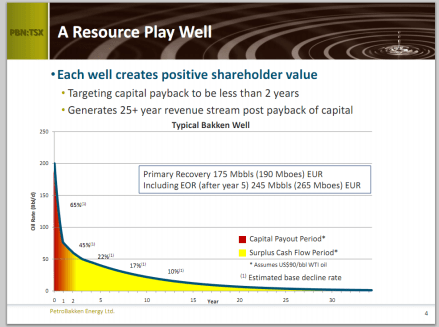
(5) Enhanced Oil Recovery promises to make it possible to extract as much as 20% higher oil than suggested by the current method of calculating reserves.  Devon Shire writes:

For example Canadian producer Petrobakken (PBKEF.PK) has reserves booked assuming a 5% recovery in its Bakken play, but believes that eventual recoveries will be 25%. I’d say Petrobakken might be exaggerating if it weren’t for the fact that its nearest rival Crescent Point Energy (CSCTF.PK) is suggesting recoveries will be 30%.

(6) PBN has non-core land assets that it could sell if it runs into cash flow problems.

(7) PBN now has a very low share price to book value ratio 0.4.  TD Waterhouse lists book price at $17.43.  In the end, a company that has excellent cash flow, increasing production, and high book value, will continue to add value to shareholders.  (Book value equals assets [land leases, equipment, infrastructure, buildings, cash on hand] minus liabilities [bank debt, convertible debentures]).  I stick to the principle of value investing as taught by Benjamin Graham in his book The intelligent investor.  If you can buy a company at book value, you are getting the future profits of the company for nothing.  If you pay less than book value, unless the company is losing money, you are getting a percentage of the assets for nothing at all.

My plan is to continue selling put options on PBN while there is weakness in the share price.  I’ve lost a lot of money on PBG/PBN already, but my experience in oil investing tells me to be patient, hold on, and become greedy when this kind of market madness sets in.   I can’t be sure that tomorrow won’t be the apocalypse, or worse, that the bottom will fall out of oil prices.  But it is a risk I think is worth taking.

Disclosure:  I am long PBG, PBN, and getting longer

Zero Hedge warns about a run on physical gold

http://www.zerohedge.com/news/chavez-pulls-venezuelas-gold-jp-morgan-great-scramble-physical-starting

According to Zero Hedge, Chavez run on physical gold may drain the banks of their physical assets, and thus result in a run on physical gold.  This would result in a parabolic rise in the price of gold, and as I suggested in an earlier post, if all the paper gold were to turn into demands for physical gold, the value of the dollar could drop to 1/56,000 of an ounce of gold.

Last week, Zero Hedge mentioned that CME increased margin requirements for gold traders.  This had an only temporary lowering effect on the price of gold; eventually, as margin requirements can be raised to the point that cash money will be able to buy gold or silver.  But this will not prevent the run on physical gold, in my opinion.