The successful DIY investor


Would you have bought this stock in January 2009? If yes, you too could become a DIY investor

Both Preet Banerjee at the Globe and Mail (see also his Lap of the blog) and Jonathan Chevreau at the National Post have written recent articles recommending that DIY investors use financial advisers.  I chose to step out completely on my own a few years ago, moving all our assets from full brokerage accounts to DIY discount brokerage accounts–the transfer fees were all paid by the receiving firm as a incentive to move our assets.  That was February, 2007.  Since that time, our retirement accounts are up a total of 154%.  I have also done well in our TFSA’s (up 40%) as well as our non-registered accounts.  Thus, I am not in the least tempted to follow their advice because I am confident that I can do well without a financial adviser.

I have learned through experience and here are some things that make DIY investor successful:

(1) Financial education:  I’ve learned through reading as much as I can from blogs and internet Newspapers including the Financial Post and Global and Mail financial page.  I’ve a limited number of books.  Benjamin Graham, The Intelligent Investor and Neill Ferguson, The Ascent of Money.  This is time consuming work, and those who don’t have the desire or the time to do it, should probably stick with index funds or a full-service financial adviser.  I’ve also occasional taken advantage of seminars or webinars to increase my knowledge–but these can be expensive so I am careful about them.

(2) Control of cash flow and leverage:  It is important to understand and control cash flow.  For example, it is probably a bad idea to buy a momentum stock using leverage.  You can never tell whether it is going to go up or down and the hold period may be much longer than expected.  By the time it goes up, the return may be greatly diminished by the interest paid.  However, it is much safer to use leverage to buy a dividend stock–as it can cover or exceed the interest rate during the entire period that it is held.

(3) Accurate tracking of results:  I keep track of such things as total net worth, total net sales of stocks, total value of stock portfolio and its net gain or loss, total debt to equity ratio, and the total amount invested in each sector (e.g., oil & gas, mining, food, banks, cash-GIC-bonds).  This makes it possible to know whether my strategies are effective or losing money and it helps me to manage risk.

(4) Specialization.  I can’t know everything about every sector.  So I invest most heavily in the oil and gas sector and am becoming more comfortable with how to evaluate the risk of buying into an energy company.  I do rely on published reports by professional analysts (at TD Waterhouse and Scotia Capital).

(5) Familiarity with different trading and investing strategies.  I use the following strategies:  Averaging down, selling of cash covered puts, and value investing–particularly the attempt to buy companies close to book value, a.k.a. shareholder’s equity.

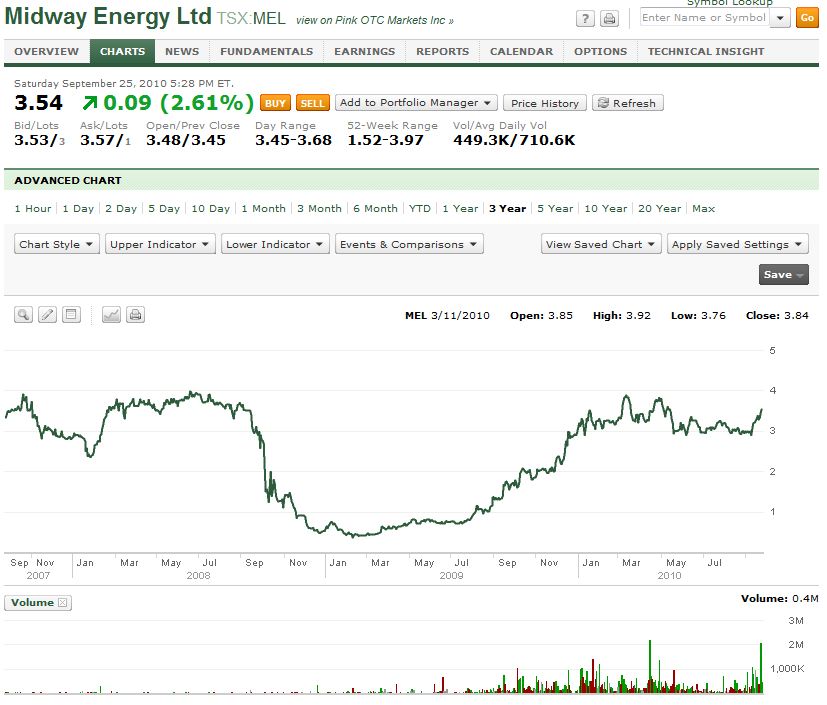
(6) Control of emotions.  The best investors are probably not always geniuses; it is probably incorrect to say that the reason Warren Buffet succeeds is because he is smarter than everyone else.  Rather, it is his ability to control fear and greed.  He can bring himself to buy when everyone else is selling and to sit on cash while everyone else is buying.  A DIY investor must be cool and collected and must be able to buy into market when all the numbers are red and sell in a market where all the numbers are green.  My most successful move was averaging down on a company whose book value per share was $3.40 but its market price had dropped to a tenth of that: that was Trafalgar Energy (now MEL).   One day it fell so low that I called their office in Calgary and the investor relations guy said that they were still generating positive cash flow.  So I overcame my utter fear of loss and bought thousands of shares that day and the next.  It turns out that it may have been the trade of a lifetime.
Do DIY investors need financial advisers?

Jonathan Chevreau of the National Post says that smart DIY investors also need financial advisers, and by this he means paid financial experts.  The crux of article is this:

You may be an expert stock-picker who doesn’t need help with security selection but are you also an expert on bonds and interest rates? How about insurance products? Options and portfolio hedging strategies? I suggest that unless you’re in the investment business yourself, it’s a rare individual investor who can master all these different disciplines.

I commented as follows:

Hi Jonathan: Thank you for this article. I think that as I DIY investor, I could tell you my story and it would perhaps contribute to this discussion. I started as a DIY investor for a couple of basic reasons: (1) My adviser charged me 2% or $80 per stock transaction (now I pay $9.99); (2) I would ask for investment ideas, and sometimes he would not respond; (3) when I suggested my own ideas, he would often take on the role of trying to talk me out of them—this was good at first, but as I gained experience I began to outgrow these limitations; (4) he would suggest putting stop losses or to sell when I felt it better to hold. I started DIY investing in 2005 and took complete control of the portfolio in 2007, when I transferred everything to my discount brokerage. My adviser’s role seems to have been to prevent me from implementing my own vision and strategy and to enforce his own. Well, I’ve had considerable success since taking over, so I am not interested in finding an adviser: there is a plethora of financial information and advice available on the internet and in books: so my advisors are many: Peter Schiff, Jim Rogers, Marc Faber, Jonathan Chevreau, Rob Carrick, Patricia Lovett-Reid, Monty Pelerin, Ivestopedia, The Dailey Reckoning, The Daily Bell, and the Business Insider, to name a few. When I’ve talked to financial people about what I do, they say, “Oh that’s really risky!” So I am not at all convinced that I would be better off seeking advice. So I am not expert in all three areas of stocks, bonds (interest rates) and insurance products. I fear inflation and therefore I am not in the market for fixed income. I don’t need any more insurance yet. I think it less important to have a mastery of these three areas, and more important to have a working strategy that leads to success. But I will admit, however, using a lawyer for estate planning and tax issues—and we also have to have an accountant to calculate our tax and give us advice about how to avoid paying tax.

Calculating book value: Case study, Petrobakken (PBN)

The value investor should pay attention to book value (assets-debt). I aspire to be a value investor, but I depend on stock analysts to do part of the work for me. Here is my dilemma. The discount brokerages make some of the research available to their clients to encourage their clients to invest in stocks. This generates revenue for them, as they depend on commissions. This is one reason to hold in suspicion their recommendations, since they will often be more optimistic than they should. If I always obtained the 52-week target price that they suggest, I would be probably be fabulously wealthy. That being said, their information is nevertheless very useful to me.

But what happens when their numbers don’t appear to agree, either with each other or with the reports from the company in question. Consider the case of Petrobakken, which both TD Waterhouse and Scotia Capital give a high rating. A couple of days ago I blogged that I would buy some shares, and I did, though the stock has continued to drop. Not to worry, I calculated that this growing oil-weighted company was selling at less than shareholder’s equity/book value; typically, if a private investor wanted to come in and buy the company, they would have to offer the shareholders premium on the book value in order to convince the majority of shareholders to relinquish the company. That means that Petrobakken is selling at a discount. I calculated the book value based upon  their quarterly report (in billions) as 5.5 (assets)-0.698 (net debt) / .188 (total shares)=$25.54 per share.

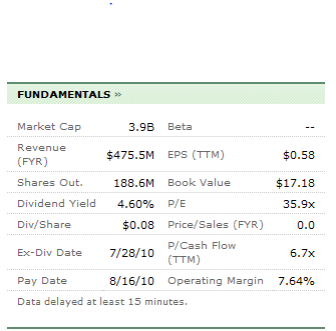
Now it is interesting to me that on TD Waterhouse website under markets and research, PBN is listed as having a book value of only $17.18:


Analyst Jason Bouvier for Scotia Capital lists PBN’s “value” at 4.467 billion and its net debt at 0.902 billion. Analyst Roger Serin at TD Newcrest (TDSI Morning Action Notes, August 11, 2010) reports PBN net debt as 1.642 billion. He provides the following explanation:

Balance Sheet – At the end of Q2/10, the company had net debt of $1.48 billion, with $557 million drawn on its recently revised covenant based $1 billion credit facility (previously $900 million reserve based). At year-end 2010, we forecast net debt of 2.5x trailing cash flow and 14% available on its current facility, or 30% with working capital deficit. Net debt includes US$750 million convertible debentures due 2016. We also note PetroBakken pays annual dividends of ~$180 million, providing additional flexibility.

I see. The debentures are added to the debt which is only correct. Using this measure we arrive at the following book value (in billions): 5.507-1.448/.1886=$21.52 per share. This is higher than the book value indicated on TD Waterhouse’s Markets and research page, and it is the price at which I purchased shares earlier this week.

Of course Petrobakken at the end of their report explain how they calculated “net debt”:

Non-GAAP Measures. This press release contains financial terms that are not considered measures under Canadian generally accepted accounting principles (“GAAP”), such as funds flow from operations, net debt and operating netback. These measures are commonly utilized in the oil and gas industry and are considered informative for management and shareholders. Specifically, net debt is used to evaluate financial leverage and includes bank debt plus and accounts payable and accrued liabilities, less current assets. Operating netback is determined by dividing oil and gas revenue less royalties, transportation and production expenses by sales volumes. Management considers operating netback important as it is a measure of profitability per barrel of production. Net debt and operating netbacks may not be comparable to those reported by other companies nor should they be viewed as an alternative to net income or other measures of financial performance calculated in accordance with GAAP.

There is no mention here of debentures. And this could explain the difference. Thus, there seems to be different ways that debt is calculated, and the DIY investor must be aware of this and dig a little deeper to make sure that the data being reported is accurate.

Book value as a determinant for buying a stock: The case of Petrobakken

At the current time, I am investing in the oil and gas industry for a number of reasons:

(1) Oil is a commodity based upon a US dollar price.  As the US dollar inflates, commodities will maintain their value.  As a result, there is likely a coming surge in the commodities in the market as everybody and his brother starts looking for value as they catch on to the severe devaluation of the US currency.  Already the Chinese, who are usually huge investors in US treasury bills, have begun to establish enormous positions in the Canadian oil sector.

(2) Current prices in the Canadian oil sector are mostly well below their 5 year highs.

(3) Canadian oil and gas companies pay really good dividends or distributions.

(4) Canadian oil companies, particularly in the junior oil sector, are often selling below “book value” or what is also called “shareholder’s equity”.

Today, for example, Petrobakken (PBN)  in their quarterly report stated that their total assets were 5.5 billion; their net debt 0.698 billion.  This means shareholder’s equity per share (total shares outstanding, 0.188 billion) = 5.5-0.698/.188=$25.54 per share.  I am not a stock analyst, so my calculations could be incorrect (and I would appreciate anyone correcting me on this).  Despite this report, because of the net loss during Q2, PBN shares fell to as low as $21.28 today, as disappointed shareholders dumped the stock.  Others like me were obviously establishing long positions.  I established long positions at an average of $21.56, which in my view means that I immediately gained equity of nearly $4 per share.  Meanwhile, before yesterday’s financial report both TD Waterhouse and Scotia Captial had given PBN excellent ratings, with a $30 and $31 52-week target price respectively [Update:  I learned that the book value of Petrobakken is probably closer to 21.52, and TD Waterhouse has lowered their 52 week target to $25].

I’ve read that Warren Buffet, the value investor par excellence,  does not like too much the commodities sector.  I comfort myself with the fact that there have been other billionaires who have made fortunes on black gold.

Canadian banks

Canadian banks have done very well and are strong in comparison to their neighbors to the south.  But one reason to be wary about investing in them is that they are expanding into the US.  While the bankruptcies are making it possible to pick up deals, my impression is that the US Federal government regulation which often led to bankruptcies is becoming worse rather than better.  Now RBC (RY) is selling a US insurance company that they picked up a few years ago, which may be an indication that they too realize that that business is becoming more difficult in the US.  But it is not surprising.  Obamacare is going to bankrupt the health insurance companies.

Despite the strength of Canadian banks, I am down to an uncovered put on BNS (agreement to buy at $45).  It’s been a great run for me.  I’ve traded successfully on TD, RY, NA, though I lost on BNS and LB (but I have overall net gain from my positions on the banks–thank you very much!).