"His master said to him, ‘Well done, good and faithful servant; you have been faithful over a little, I will set you over much; enter into the joy of your master.'"
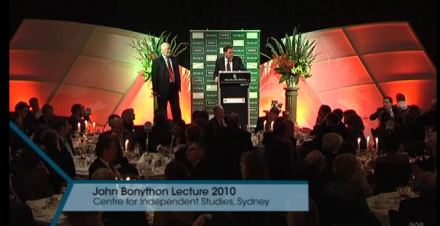
Speaking to the Center for Independent Studies in Australia, Niall Fergusson predicts the rapid demise of American hegemony in the world. He explains that many empires did not ebb away but rapidly fell–however, in many cases, it wasn’t really military weakness that did them in, but debt, particularly debt to foreigners. He says America is on the same path. He makes the observation that China, which is rising in power, is quietly reducing its holdings of US debt.
Ferguson is asked during the question period whether he owns gold. He says that one should only have 10% of holdings in gold, for he believes that there will be deflation. Funny, in my reading of his book, The Ascent of Money, and my listening to media appearances, I’ve drawn the opposite conclusion from the evidence that he presents: that there will be inflation. Ferguson, however, makes the point that he is not himself an economist (like that would necessarily help) but an historian. In any case, I hope the leadership and people of the US are listening to his warning. It is perhaps not too late to turn the tide. Ferguson recommends the newly elected Senator Rand Paul as being the only one who has a reasonable plan to help the US to avoid this fall. Please click on the screen snip below to connect to the video at the Australian Broadcasting Corporation website (hat tip The Business Insider).
While in Grand Cayman over the Christmas holiday, I finished Justinian’s Flea by William Rosen–a little light historical reading. In the sixth century AD, when armies would besiege, cities could pay a ransom and avoid violence that could result in a massacre or a selling into slavery of the population. But in no case did the besiegers accept fiat currency–their preference was for gold and silver. Imagine the Emperor at Constantinople asking the invading hoards if they would accept a promissory note or nice pieces of papyrus with his picture on it? Thus, history teaches us that war helps people to sort out their values. The enemy wants what is mine, and the main thing I have besides my very life is gold and silver; otherwise, I am unable to ransom myself. It is better to relinquish precious metals than to die or to become a slave for the rest of my life.
Larry Norman wrote in his 1969 song, “I’d wish we’d all been ready”:
Children died, the days grew cold.
A piece of bread could buy a bag of gold.
I wish we’d all been ready.
It is a beautiful song marred by the flawed dispensational theology of the Rapture. Yet these lines have always haunted me. What has value in a time of war when everyone is desperately seeking merely to survive with life and limb and to protect their loved ones? Norman’s song evokes an image of a time so desperate that gold would have no value–only bread. Could this fit the mantra of some that gold has no intrinsic value? I would argue that in such a scenario it is not that gold has lost value: it’s that bread has become so scarce so as to increase in market value, and this is what actually happens in war.
Some of my African colleagues testified that during one of the many wars that Bangui experienced, the seminary community remained on campus fearing for their lives as shooting and shelling raged in the city’s streets. Some brave bread vendors dared to distribute despite the danger. But instead of asking the pre-war price of 50 CFA per mini-baguette (=$0.125US), they wanted 200 CFA. Those who were too afraid to step out into the open paid the premium or they went without. Scarcity led to higher prices. Economics 101. Even graduates of Father Guido Sarducci’s 5-minute University should be able to apprehend this basic concept.
The increased price of commodities during times of war notwithstanding, it is clear to me that history teaches us that in the most severe economic crises, gold and silver retain their value while currencies do not–particularly the debt instruments of the war’s vanquished. As a child growing up in America, I read several tales of people who had found millions of dollars only to learn that they were worthless Confederate notes. Bank notes are debt. Debt which the issuer cannot repay is worthless. Gold, however, does not suffer from such issues. So in the end, the victor walks away with the gold and the loser sits upon a pile of worthless paper. In times of war, it can be difficult to pay for supplies and soldiers with the promissory notes that we call currency. So for example, Niall Ferguson writes in his The Ascent of Money (81-85) about how the British, facing the refusal of their promissory notes, successfully received gold, thanks to the shipments arranged by the Rothchilds, and were able to win a decisive victory against the French at the Battle of Waterloo in 1815.
There are increasingly those who predict hyperinflation, which is popularly defined as rapidly-rising prices that soon reach un-payable levels, and which is always caused by the true definition of inflation, which is (according to the Mogambo Big Book Of Economic Stuff (MBBOES), “A gigantic growth in the money supply, which is caused by banks deliberately acting like greedy, lying, filthy pigs who deserve to be thrown in jail.”
I have nothing but disdain for the view that gold has no intrinsic value. A friend sent me a link to Howard Marks most recent newsletter, “All that Glitters“. Marks is the chairman and principal of Oaktree Capital, which largely invests in distressed debt. If that works for him, brilliant. But perhaps pressure from clients has caused him to defend himself regarding his firm’s failure to have any gold exposure. It leads him to write the following nonsense (emphasis his):
There’s little intrinsic to gold that enables it to serve as a store of value and a hedge against inflation. Gold serves those purposes only because people impute to it the ability to do so. It’s self-deception, nothing but the object of mass hysteria like that exhibited in “The Emperor’s New Clothes.” Gold has no financial value other than that which people accord it, and thus it should have no role in a serious investment program. Of this I’m certain.
Marks continues by saying that currencies are also flawed in this regard, but no matter. Gold’s value is only what people impute to it. His main point is that currency investments create cash flow, but gold doesn’t, and therefore it is not a safe investment vehicle because it depends entirely on this uncontrollable factor of what value the “people” place upon it.
Gold however does have intrinsic value. So much, in fact, that one would never imagine using it as a door handle in the place of brass–unless one had a security detachment to guard the handle from theft. Stylish brass door handles are expensive, though well within the price range of the average house owner. But even brass has intrinsic value. So why do people insist that gold has little or no intrinsic value? Because they have completely lost a grip on reality, that’s why. Gold would make better door handles than brass because gold doesn’t tarnish. It would make prettier counter top than stainless steel. Gold makes better cutlery than tarnishable silver. And why don’t jewelers use brass in jewelry? Because after a year or two brass jewelry would look hideous–just like the brass handle to our front door.
This whole “gold-has-no-intrinsic-value” mantra is so pervasive that Marks entitles his letter, “All that glitters”; this line of traditional wisdom that says more fully, “All that glitters is not gold.” This is a warning that while there may be all kinds of things that are as pretty and shiny like gold, they are not substitutes for the real thing and that one should not be fooled by them. So those who use this saying to insult the intrinsic value of gold are turning the traditional wisdom on its head and claiming that gold may glitter but its not gold. What nonsense.
It is true that precious metals fluctuate in value day to day. But this is due largely to the increased instability in the value of fiat currencies. Central banks have tacitly instructed the public that these instruments have no value by artificially setting the interest rates at or around zero. I believe that gold will only exit its current bull market if interest rates are allowed to return to market rates: I would guess that means they must rise to about 25%. Paper currencies which have no deposit value, i.e., they cannot create adequate cash flow when deposited in savings accounts, GICs or even government debt instruments, cannot compete with hard money (gold and silver) which have intrinsic value.
I argued in a previous post that when banks create money electronically we shouldn’t call it “printing money”; the metaphor doesn’t adequately describe a situation in which most money is not printed but created electronically on the balance sheets of the major financial institutions then passed on to the public through electronic transfers, credit cards, debit cards, and the like. Most money is not printed–it is a virtual reality that people accept in exchange for very real goods and services. In my view, this situation is analogous to a game of monopoly. During the game, the money is received in the form of salaries, rents, gifts, and bonuses, and in turn it can be used to pay rent, mortgages, penalties, and taxes. In the end, when the game is over, all the money goes back into the box and regresses to its intrinsic value of zero. But Monopoly is just a game, you say? But so is our virtual economy. It’s a game we are playing with non-real money which has no intrinsic value, not even the paper its printed on, because the central banks don’t bother to print much of it anymore.
Monopoly games last about 1-3 hours. It is not certain how long virtual economy game will last, but it won’t be much longer with Ben Bernanke keeping interest rates at virtually nothing and creating virtual money ex nihilo–eventually the public will stop accepting it in exchange for real goods and services. That will be the end of the game, and at real money with intrinsic value, like gold and silver, will become the norm. And we shouldn’t make the mistake of saying that gold has no intrinsic value because it can’t be eaten. That is a fallacious argument created by fascists trying to confuse the issue. Gold and silver have intrinsic value by definition.

 The Righteous Investor