Here is video by Diet Doctor explains the LCHF food revolution in Sweden. Very interesting for those who want to regain their health through eating a paleo diet.
carbs are poison
Veganism is over-realized eschatology
Isaiah 65:25 (RSV):
The wolf and the lamb shall feed together, the lion shall eat straw like the ox; and dust shall be the serpent’s food. They shall not hurt or destroy in all my holy mountain, says the LORD.
Vegans are right. But they are too early. One name for this is an over-realized eschatology. In the terminology of New Testament theology, they have too much “already” and not enough “not yet”. But one day, the physiology of even the most carnivorous of animals will turn to eating straw fiber. But that day is not yet. Even feed a cat a vegan diet and it would eventually die of malnourishment.
Can you gain body fat on 5000 calories a day for 21 days?
Stupid question? People gain weight all the time on seven-day cruises, where news articles have told us that the typical weight gain for passengers on a seven day trip is 1 lb per day. But what if the macro ingredients of those calories were low carb high fat (LCHF-10% carbohydrates, 50% fat and 40% protein). Sam Feltham did this last Spring. He gained about 1 kg but lost 3 cm from his waist.
Fat in the absence of carbohydrate is not the devil. The devil is in the carbs.
The Battle of the Diets: Stanford Professor reports that the result of his research on diets was a bitter pill
Standford nutritionist and vegetarian, Christopher Gardner, says that his research showing low carb diets as the most effective for losing weight and controlling lipid markers says that it was a bitter pill to swallow.
A ketogenic diet as a preventative and treatment for malaria
It is not as if diabetics don’t have it hard enough. They already have increased risk of cancer, kidney disease, cardiovascular disease, and Alzheimers? But it is now becoming clear that one of the deadliest diseases on the planet, malaria, also attacks diabetics with great efficiency. Thus, a study in Ghana has linked diabetes and increased malaria. Malaria kills about one million people every year. Could it be that a high-carbohydrate diet that leads to uncontrolled blood sugars also makes one susceptible to malaria?
Malaria is caused by a parasite that inhabits red blood cells (erythrocytes). The infected cells have an enormous requirement for glucose (emphasis mine):
Malaria parasites also are dependent on glucose as a nutrient source. As Plasmodium has no capacity to store energy in the form of glycogen they rely entirely on an exogenous supply of glucose. The infected erythrocyte exhibits a substantial increase in its permeability to low molecular weight sugar. The metabolism of the parasite utilizes up to 75 times more glucose than uninfected erythrocytes. Glucose is vital for Plasmodium. An in vitro study (H Humeida et al., J of Diabetology, October 2011, 3:6) has shown that growth and proliferation is impaired below 5.5 mM.
I wonder if a person had constantly normal blood sugars (4.3-4.6 according to Richard K. Bernstein), which can only be achieved through fasting or ketosis, whether this would ward off malaria. Apparently so. Malaria apparently recurs in famine victims as a result of refeeding (Anuraj Shankar, “Malaria and Nutrition”, 229f. in Nutrition and Health in Developing Countries, Richard D. Semba, Martin W. Bloem eds.):
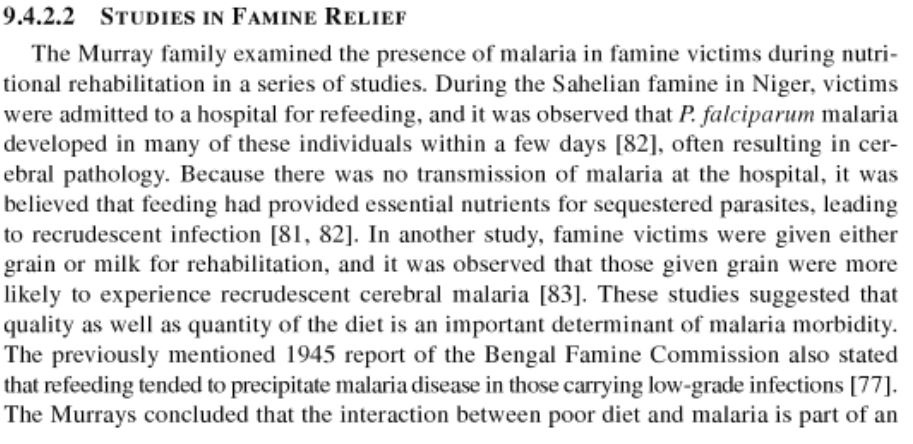

Thus, the moment that the starvation victim receives anew a high carb diet, the malaria parasite seizes the opportunity to multiple. Apparently, the ketogenic state of starvation makes it difficult for the parasite to obtain adequate glucose. It stands to reason that the uncontrolled blood glucose is the the reason that diabetics are at greater risk of malaria. My guess is that a low-carb high-fat diet would greatly reduce the risk of malaria. In addition, perhaps fasting followed by a ketogenic diet should be recommended along with anti-malarial medications as a treatment. If a person can afford no other treatment, perhaps fasting could potentially act as a cheap cure.
So carbs are poison not only because of the damage that high blood sugars cause to bodily tissues but because of the parasites that the high carbohydrate diet promotes. This includes Candida (yeast infections), parasitic worms and Lyme disease. And now we can add malaria.
 The Righteous Investor